
Some tarot cards feel quiet. The Chariot does not. It shows up when life starts pulling in different directions and asks one hard question: who is actually steering?
The Chariot tarot card meaning is about directed will, self-control, and moving forward with purpose. In most tarot traditions, this card points to momentum, discipline, and the need to align conflicting forces instead of letting them drag you off course.
That is why this card often lands in moments of pressure. You may already know what you want. The real issue is whether your actions, emotions, and priorities are moving together.
What does The Chariot represent?
The Chariot represents focused movement.
It is the card of choosing a direction and holding it, especially when distractions, fear, ego, or outside pressure try to take over. The Chariot tarot card meaning is not just “success” in a simple sense. It is success that comes from effort, restraint, and conscious direction.
This card usually appears when determination matters more than mood.
It can also point to a turning point. Not because something magical changes on its own, but because you stop waiting to feel perfectly ready and begin acting with intention.
Symbolism and key themes
The Chariot is built around tension.
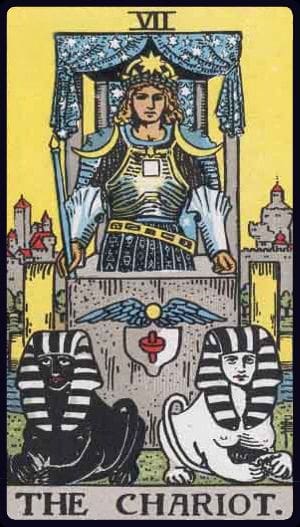
In many decks you may see a charioteer, a vehicle or carriage, armor, a canopy or stars above, and two animals pulling in different directions. A common depiction is a figure standing or sitting upright, looking composed while the forces below remain divided.
Some of the most common visual motifs include:
- a chariot or carriage
- two sphinxes, horses, or other paired animals
- black and white contrast
- armor or protective clothing
- a crown, helmet, or symbols of authority
- stars, moons, or a marked canopy
- a city or structure behind the figure
These details matter because they show the card’s central tension: movement depends on control, but control does not mean suppression. The charioteer does not destroy opposing forces. They learn to direct them.
That is the heart of The Chariot tarot card meaning. It is about managing contradiction.
You want freedom, but you also want stability.
You want change, but you fear the cost.
You feel strong, but part of you still hesitates.
The card does not ask you to become one-note. It asks you to become integrated.
The core tension inside The Chariot
The Chariot is about control, but not rigid control.
That distinction matters. Healthy control gives structure to desire. Unhealthy control turns into force, denial, or emotional lockdown. The Chariot tarot card meaning sits exactly between those extremes.
You need enough discipline to move.
You need enough honesty to know what is driving you.
If you keep pushing without reflection, the card can describe burnout, defensiveness, or success that feels oddly empty. If you stay in reflection without movement, it can point to stagnation dressed up as caution.
The challenge is not speed. The challenge is alignment.
Psychological meaning of The Chariot
Psychologically, this card often points to self-mastery.
That can sound dramatic, but in real life it is usually ordinary. It is the moment you stop reacting automatically. You notice your impulses, your pride, your fear, your frustration, and you decide not to hand them the wheel.
The Chariot tarot card meaning often connects to:
- emotional regulation
- strong boundaries
- ambition with structure
- confidence that comes from action
- tension between instinct and discipline
It can appear during periods when identity feels tied to performance. You may be trying to prove something. To yourself. To a partner. To a parent. To a team. The card asks whether your drive still serves you, or whether it has started to own you.
In that sense, The Chariot is not just a “go” card. It is also a mirror for motive.
A real-life moment with The Chariot
A woman gets offered a promotion she has wanted for years. On paper, it looks perfect. Better title. Better pay. More influence. She says yes almost immediately because she does not want to look uncertain.
Then the strain starts.
She becomes impatient with people. She sleeps badly. Every small mistake feels threatening. She keeps telling herself to push harder, but the harder she pushes, the less clear she feels. One evening, after another tense call, she realizes what tarot told me in that moment was not whether the job was right or wrong, but that she had stepped into it in a way that left no room for her actual values.
The Chariot helps unpack moments like that:
- The problem may not be the goal itself. It may be the way you are forcing yourself to pursue it.
- Opposing forces often exist at the same time: ambition and fear, pride and doubt, discipline and resentment.
- Real control starts when you name those forces honestly instead of pretending they are not there.
The Chariot in love, career, and personal growth
In love
In relationships, The Chariot often points to direction.
That can mean deciding where something is going. It can also mean noticing where control, defensiveness, or emotional distance is shaping the connection. The Chariot tarot card meaning in love is rarely soft, but it can be useful. It asks whether both people are moving with intention or simply reacting.
Sometimes this card shows healthy commitment.
Sometimes it shows a need to stop treating closeness like a competition.
If you read tarot alongside cards like Two of Cups or The Lovers, the contrast becomes clearer. Those cards ask about connection. The Chariot asks who is steering the relationship dynamic.
In career
In work, this card often looks strong.
It can point to ambition, leadership, momentum, travel, progress, or taking charge of a situation that has become messy. Still, The Chariot tarot card meaning in career is not just “you will win.” It is “your outcome depends on how well you direct your energy.”
This card often appears when you need to:
- commit to a plan
- stop splitting attention across too many priorities
- act with more authority
- manage pressure without becoming rigid
If you also reflect on cards like Eight of Pentacles or Strength, you may see a useful pattern. The Chariot pushes forward. Eight of Pentacles refines the craft. Strength softens force into steadiness.
In personal growth
For self-development, The Chariot often marks a phase of active agency.
You stop waiting for clarity to arrive from outside. You build it through decisions. That does not mean rushing. It means taking responsibility for pace, boundaries, and direction.
This card can be especially meaningful when you are recovering from confusion. It says you may not control every condition, but you can still choose how you respond.
When it feels supportive
The Chariot can feel supportive when:
- you finally commit to one clear direction
- your confidence comes from practice, not performance
- you hold boundaries without shutting down emotionally
When it feels blocked
The card can feel blocked when:
- you try to control everything, including other people
- you confuse urgency with purpose
- inner conflict keeps leaking into your choices
Reflection questions for The Chariot
The best reflection questions make the card more specific.
Try these:
- What in my life currently needs direction, not just effort?
- Which two forces inside me feel like they are pulling apart?
- Where am I acting disciplined, and where am I just tense?
- What am I trying to prove through movement or achievement?
- What would steady progress look like without overcontrol?
- Where do I need a clearer boundary to protect my focus?
These questions work well in tarot journaling because they shift attention away from prediction and back to pattern.
How to reflect on The Chariot
A good way to reflect on this card is to slow the story down.
Write down the situation that feels urgent. Then separate facts from reactions. After that, name the forces pulling in opposite directions. Desire and fear. Pride and vulnerability. Action and avoidance. Tarot Told Me is a reflective tarot app designed to help explore situations through symbolism, inner dialogue, and mindful reflection. In practice, this kind of structure can make the card less abstract and more honest, especially when you return to a daily card or a repeated question over time.
You can also keep it simple:
- Name the goal.
- Name the pressure.
- Name what keeps pulling you off course.
- Decide what kind of control would actually help.
That is where a reflective tarot practice becomes useful. The card stops being a symbol you admire from a distance and becomes a way to observe how you move through tension.
Further reading
- The Lovers Tarot Card Meaning: Relationships, Choice, Emotional Alignment
- Can You Read Tarot for Yourself? What Beginners Should Know
- The Hierophant Tarot Card Meaning: Tradition, Learning, Guidance
Frequently asked questions
What does The Chariot mean in tarot?
The Chariot usually means direction, discipline, and determined movement. It often appears when success depends on focus and self-control.
Is The Chariot a positive or negative card?
It is neither purely positive nor negative. Its energy can be productive and empowering, but it can also become rigid if control turns into force.
What does The Chariot mean in love?
In love, The Chariot often points to direction, commitment, and emotional control. It can also show a need to stop treating closeness like something to manage too tightly.
What does The Chariot mean reversed?
Reversed, this card often suggests scattered energy, lack of direction, frustration, or overcontrol. It may reflect movement without alignment.
How can I use The Chariot in daily reflection?
Use it to ask where your energy is going and what is driving your decisions. The Chariot tarot card meaning becomes clearer when you connect it to one real situation instead of treating it as a grand message.
The Chariot tarot card meaning is not about crushing doubt or pretending conflict does not exist. It is about seeing your competing drives clearly enough to lead them. Sometimes progress begins the moment you stop asking whether you feel ready and start asking what deserves your direction now.