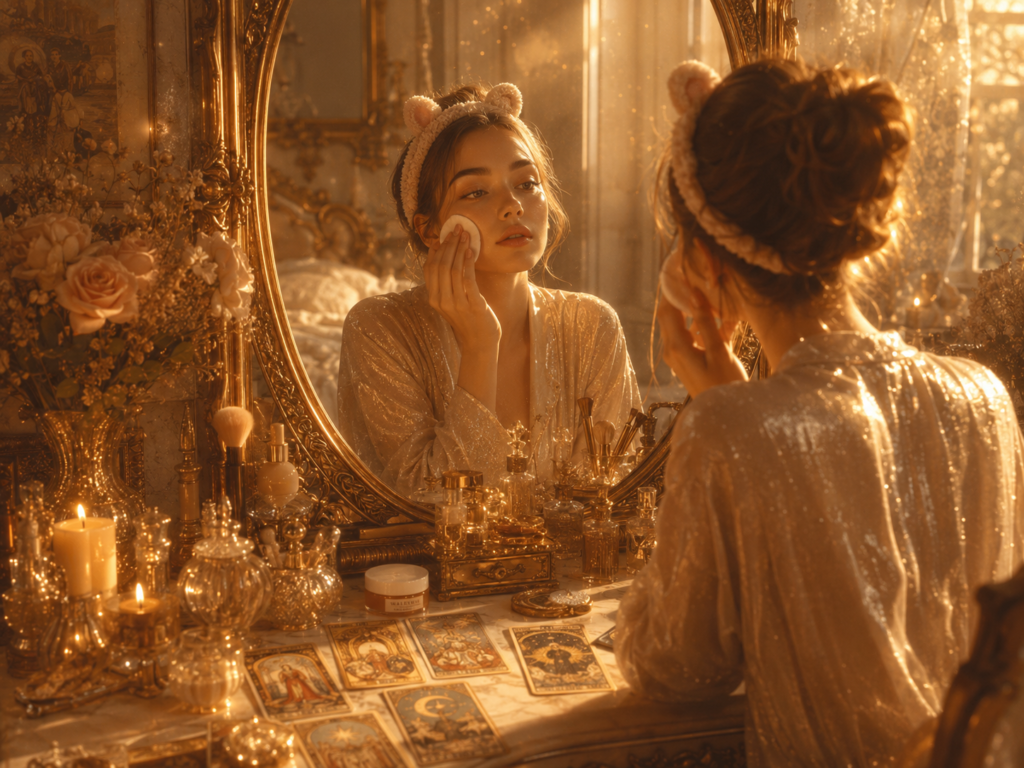
An evening tarot reflection practice is a simple way to close the day with one card, one honest question, and one short note.
The goal is not to predict tomorrow. It is to look back at today.
What did you notice?
Where did you react automatically?
What felt heavy?
What felt meaningful?
What do you want to release before sleep?
A good evening tarot reflection practice can take five minutes. You pull one card, connect it to the day you just lived, and write one small insight.
Definition: An evening tarot reflection practice is a one-card tarot ritual used at the end of the day for journaling, emotional processing, pattern recognition, and closure. Instead of asking “What will happen next?”, you ask “What did today show me?”
Why evening tarot reflection works
Morning tarot helps you choose what to notice.
Evening tarot helps you understand what you noticed.
At the end of the day, you have real material: conversations, decisions, small irritations, unexpected moments, avoided tasks, emotional shifts, and things you carried without naming.
A tarot card can help you organize that material.
It can become a prompt for asking:
- What did I learn today?
- What emotion stayed with me?
- What pattern repeated?
- What did I avoid?
- What am I ready to let go of?
- What do I want to remember tomorrow?
This makes evening tarot reflection different from a nightly prediction ritual.
You are not asking the card to tell you what is coming.
You are using it to make sense of what already happened.
A simple 5-minute evening tarot reflection practice
Use this when you want a small ritual before bed.
1. Choose one question
Pick a question that helps you review the day.
Good evening tarot reflection questions:
- What did today show me?
- What emotion needs to be named before I sleep?
- What pattern did I repeat today?
- What did I handle better than before?
- What am I ready to release from today?
- What do I want to carry into tomorrow?
- What needs gentleness tonight?
Avoid questions like:
- What will happen tomorrow?
- Will they text me?
- Is something bad coming?
- What should I worry about?
- Did I ruin everything?
Evening tarot should help you land, not activate your anxiety before sleep.
2. Pull one card
One card is enough.
At night, your mind may already be tired. A full spread can create too much interpretation.
A single card gives the day one mirror.
3. Write your first reaction
Before reading the meaning, write what you notice.
- What part of the image stands out?
- What feeling appears?
- Does the card feel like the whole day or one specific moment?
- Does it remind you of a conversation, choice, emotion, or pattern?
Keep it honest.
You can write:
This card feels exactly like my day.
Or:
I do not understand this card, but the image feels quiet.
Or:
I feel annoyed by this card. Maybe I do not want to admit I am tired.
That first reaction is part of the reflection.
4. Connect the card to one moment from the day
Choose one specific moment.
Not the whole day.
Not your whole life.
One moment.
Examples:
- a message you did not answer;
- a meeting that drained you;
- a small win;
- a conflict;
- a moment of rest;
- a decision;
- a repeated thought;
- something you avoided.
This keeps the reading grounded.
5. End with one release or one reminder
Before you close the journal, write one sentence:
Release:
Tonight I can let go of…
Reminder:
Tomorrow I want to remember…
Examples:
- Tonight I can let go of trying to solve this before sleep.
- Tonight I can let go of replaying the conversation.
- Tomorrow I want to remember to ask directly.
- Tomorrow I want to remember that small progress still counts.
That is a complete evening tarot reflection.
Example: Four of Cups at night
Question: What emotion needs to be named before I sleep?
Card: Four of Cups
First reaction: Emotional distance. Tiredness. Not wanting to engage.
Moment from the day: I ignored a message because I felt too drained to answer.
Reflection: I may not be uninterested. I may be overstimulated. I need to separate emotional numbness from lack of care.
Release: Tonight I can let go of guilt for not being instantly available.
Reminder for tomorrow: Answer when I have enough capacity to be clear.
The card does not accuse you.
It helps you name what happened.
Example: Six of Swords at night
Question: What did today show me?
Card: Six of Swords
First reaction: Transition. Quiet movement. Leaving something behind.
Moment from the day: I finally admitted that one plan is not working.
Reflection: I may be in the middle of a transition, not at the end of it. Today was less about a big decision and more about accepting the direction.
Release: Tonight I can let go of needing the whole path to be clear.
Reminder for tomorrow: One small crossing still counts.
This is the strength of evening tarot.
It can turn an ordinary day into a clearer story.
A simple evening tarot journal template
Use this before bed:
Date:
Question: What did today show me?
Card:
First reaction:
One moment from today:
What this card helps me notice:
What I can release tonight:
What I want to remember tomorrow:
Short version:
Card:
Today this reminds me of:
Tonight I can let go of:
Tomorrow I want to remember:
The short version is enough when you are tired.
A useful evening tarot reflection practice should not become another task to perform.
Best evening tarot questions
For emotional processing
- What feeling stayed with me today?
- What emotion needs a name before I sleep?
- What did I not let myself feel today?
- What felt heavier than expected?
- What needs gentleness tonight?
For pattern recognition
- What pattern did I repeat today?
- Where did I react automatically?
- What did I avoid?
- What did I overthink?
- Where did I say yes too quickly?
- Where did I protect myself well?
For gratitude and memory
- What do I want to remember from today?
- What small moment mattered?
- What gave me energy?
- What helped me feel connected?
- What did I handle better than before?
For closure
- What can I release tonight?
- What does not need to be solved before sleep?
- What can wait until tomorrow?
- What am I allowed to put down?
- What would help me end the day softly?
For tomorrow
- What do I want to carry into tomorrow?
- What lesson from today is useful?
- What boundary should I remember?
- What small next step is enough?
- What would make tomorrow 10% calmer?
What not to ask at night
Nighttime is not always the best time for intense tarot questions.
Before sleep, avoid questions that increase anxiety or rumination.
Try not to ask:
- What will go wrong tomorrow?
- Is this relationship doomed?
- What are they thinking about me?
- Did I make the wrong choice?
- What should I panic about?
- Will I regret this?
These questions can turn the card into a worry machine.
A safer evening version is:
Instead of: Did I make the wrong choice?
Ask: What did this choice teach me today?
Instead of: What are they thinking?
Ask: What did I feel in this interaction?
Instead of: What will happen tomorrow?
Ask: What can wait until tomorrow?
Instead of: Is everything falling apart?
Ask: What needs support, and what can I put down tonight?
The goal is closure.
Not another open loop.
If you pull a difficult card before bed
Difficult cards can feel especially intense at night.
If you pull the Tower, Death, the Devil, Three of Swords, Ten of Swords, or Nine of Swords, pause before interpreting.
Use this structure:
Card:
My immediate fear:
What actually happened today:
A grounded interpretation:
What I can release tonight:
Example:
Card: Nine of Swords
Immediate fear: Something is wrong.
What actually happened today: I replayed one conversation for hours.
Grounded interpretation: This card may reflect rumination, not reality.
Release: Tonight I can let go of trying to solve this in my head.
Next step: Write one fact and one worry, then stop.
This protects the practice from becoming fear-based.
The card is not a punishment.
It is a mirror.
Evening tarot for overthinking
If your mind becomes loud at night, tarot can either help or make it worse.
It helps when you use one card to name the loop.
It makes things worse when you pull card after card trying to feel certain.
Use this instead:
The thought I keep replaying:
Card:
What this card helps me name:
What I know for sure:
What I am imagining:
What can wait until tomorrow:
Example:
The thought I keep replaying: I sounded stupid in that meeting.
Card: Page of Swords
What this card helps me name: I am still learning how to speak clearly under pressure.
What I know for sure: I asked one question. Nobody reacted badly.
What I am imagining: That everyone judged me.
What can wait until tomorrow: Deciding whether I need to clarify anything.
This is not about forcing calm.
It is about separating fact from fear.
Evening tarot for relationships
Evening relationship reflection should stay focused on your experience.
Try not to use nighttime tarot to investigate another person’s mind.
Instead of asking:
What do they feel about me?
Ask:
What did I feel in this connection today?
Instead of:
Will they come back?
Ask:
What am I waiting for before I return to myself?
Instead of:
Did I ruin this?
Ask:
What actually happened, what did I assume, and what do I need to ask directly?
Useful questions:
- Where did I feel seen today?
- Where did I feel unseen?
- Did I communicate honestly?
- What did I need but not ask for?
- What boundary did I respect or ignore?
- What do I want to bring into tomorrow’s conversation?
Evening tarot can help you process connection without turning the card into mind-reading.
Evening tarot for work
Work can follow you into the evening.
A card can help you close the loop.
Ask:
- What am I still carrying from work?
- What task does not need to come to bed with me?
- What did I handle well today?
- Where did I overextend?
- What can wait?
- What needs a clearer boundary tomorrow?
Example:
Question: What am I still carrying from work?
Card: Seven of Wands
First reaction: Defensiveness. Holding my ground.
Reflection: I may still be bracing from the meeting. I do not need to keep defending my position alone in my head tonight.
Release: Tonight I can let go of rehearsing arguments.
Reminder for tomorrow: Write the decision clearly and move on.
This is how evening tarot can support closure.
Not by solving work.
By helping you stop carrying it into sleep.
A 3-minute evening tarot practice
For tired nights:
- Pull one card.
- Name one moment from the day.
- Write one sentence: “This card reminds me that…”
- Write one release: “Tonight I can let go of…”
Example:
Card: Four of Pentacles
Moment: I kept checking my budget and felt tense.
Sentence: This card reminds me that control is not the same as safety.
Release: Tonight I can let go of solving every money fear before sleep.
That is enough.
A 10-minute evening tarot practice
For deeper reflection:
- Choose one question.
- Pull one card.
- Write your first reaction.
- Connect the card to one moment from the day.
- Name the emotion.
- Name the pattern.
- Write what you can release.
- Write what you want to remember tomorrow.
This works well with tea, soft music, dim light, or any small routine that signals the day is ending.
The ritual does not need to be elaborate.
It needs to be repeatable.
Set the mood: Tarot Radio Live
Evening tarot reflection works best when the practice feels calm, not dramatic.
You can use Tarot Radio Live as a soft background while you journal, pull one card, and close the day.
How Tarot Told Me supports evening reflection
Tarot Told Me is built for tarot as reflection, not prediction.
For an evening tarot reflection practice, the app helps you save the question, card, first reaction, and end-of-day note in one place.
That matters because daily reflection becomes more useful over time.
A single evening card can show what you are processing tonight. A saved archive can show what tarot told me across many days: the emotions that keep returning, the patterns you repeat, the cards that appear around stress, and the small reminders that help you move forward.
You can save your tarot questions and reflections in Tarot Told Me, then return to them later with more distance.
Suggested reading
- Tarot and Cognitive Reframing: How a Card Can Change the Question
- Why Journaling Helps: The Psychology of Writing Things Down
- Tarot Journaling: A Complete Guide to Using Cards for Self-Reflection
FAQ
What is an evening tarot reflection practice?
An evening tarot reflection practice is a short end-of-day ritual where you pull one card and use it as a prompt to review the day, name emotions, notice patterns, and create closure before sleep.
What should I ask during evening tarot?
Good evening tarot questions include “What did today show me?”, “What emotion needs to be named?”, “What can I release tonight?”, and “What do I want to remember tomorrow?”
Should I pull tarot cards every evening?
You can, but you do not have to. Evening tarot is useful only if it supports clarity and closure. If it starts to feel compulsive or anxious, reduce the frequency.
Is evening tarot a prediction for tomorrow?
It does not have to be. In reflective tarot, an evening card is not a prediction. It is a prompt for reviewing the day and noticing what you want to carry forward or release.
What should I write after an evening tarot pull?
Write the card, your first reaction, one moment from the day, what the card helps you notice, what you can release tonight, and what you want to remember tomorrow.
What if I pull a scary card at night?
Treat it as a reflection prompt, not a warning. Write your immediate fear, then connect the card to something that actually happened today in a grounded way.
Can I combine morning and evening tarot?
Yes. You can pull a card in the morning as a focus, then review it in the evening. This turns daily tarot into a reflection cycle instead of a prediction habit.