Estimated reading time: 18 minutes
Table of contents
- How to Read Tarot Cards in a Way That Makes Sense
- How to read tarot cards in simple terms
- What tarot reading actually is
- What you need before your first tarot reading
- Start with a question that gives the reading direction
- How to choose a tarot spread without making things messy
- How to interpret tarot cards without memorizing every meaning
- Read the spread as a whole, not as separate card definitions
- A simple step-by-step tarot reading method for beginners
- Three examples of how tarot interpretation works in practice
- Why tarot can feel accurate even when it is symbolic
- Common mistakes beginners make when reading tarot
- How to get better at reading tarot over time
- How to use tarot without becoming dependent on it
- Beginner mini-guide: what to do the next time you pull cards
- Final thoughts on how to read tarot cards
- FAQ
- Researchers and ideas behind this article
Key Takeaways
- Beginner tarot reading often confuses card meanings with actual interpretation, causing disconnection between ideas.
- To read tarot cards, ask a clear question, choose a simple spread, and interpret cards in relation to each other and the question.
- A better approach involves seeing patterns in the spread instead of focusing on individual card definitions for more coherent readings.
- Common beginner mistakes include asking vague questions, pulling too many cards, and ignoring positions within spreads.
- Reflective practice, like keeping a tarot journal, improves clarity and helps you evolve your reading skills over time.
How to Read Tarot Cards in a Way That Makes Sense
Most beginner tarot advice stops being helpful right when you need it most.
Usually, it gives you card meanings, a few keywords, and maybe a simple spread. Then, however, it leaves you with the part that actually matters: how to turn all of that into a reading that says something real.
That is where many beginners hit a wall. They pull a few cards, look up the meanings, and then end up staring at a list of ideas that do not quite connect. One card points to change. Another suggests fear. A third hints at balance. All right. But what does that add up to? What is the reading actually trying to show you?
This guide is meant to help with that part. Instead of making tarot feel vague or overly mystical, it focuses on how to read the cards in a way that feels clear, practical, and useful. In other words, the goal is not to squeeze certainty out of symbols. Rather, it is to use them as a way to understand a situation more clearly, put honest words to what is happening, and ask better questions.
How to read tarot cards in simple terms
To read tarot cards, begin with a clear question, pull a simple spread, and look at each card in context. Start with the card’s core meaning, then consider how it connects to the question, the position it appears in, and the other cards around it. A strong reading does not come from collecting more definitions. Instead, it comes from noticing the pattern the cards create together.
For many beginners, that is the shift that changes everything. Tarot becomes more useful once you stop reading each card like a separate fortune-cookie message and start seeing the spread as a single response.
Quick takeaway: Tarot works better as a tool for reflection than as a tool for certainty. The cards are most useful when they help you see a situation more clearly, not when you ask them to remove ambiguity from life.
What tarot reading actually is
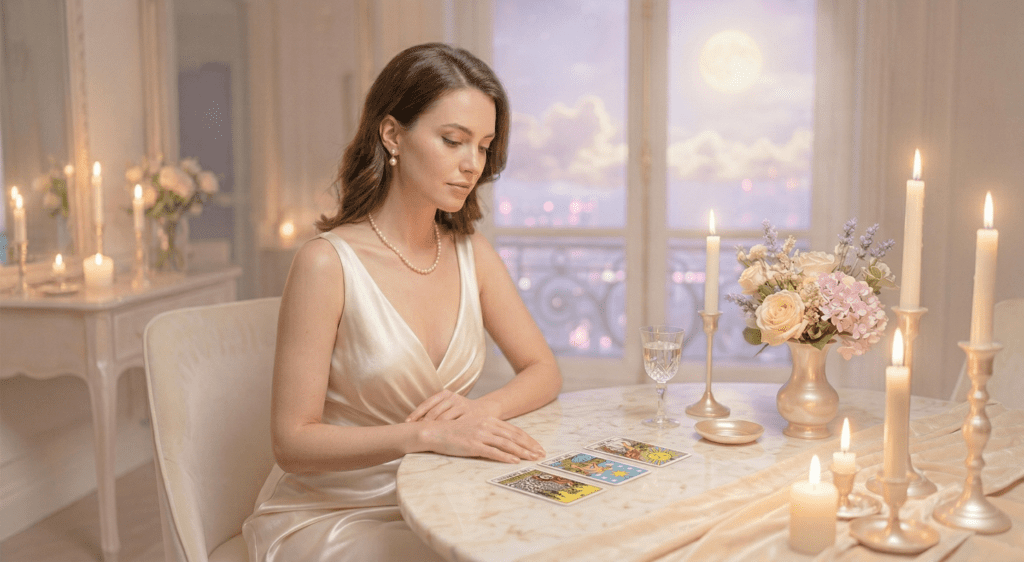
A simple way to define tarot reading is this: it uses symbolic cards to help you think through a situation more clearly.
That distinction matters. Many beginners come to tarot thinking the goal is to crack some hidden code. In reality, the more important skill is interpretation. The cards give you a structure, but the real work is in connecting that structure to an actual question, a real-life situation, and the tension inside it.
That is also why tarot can feel valuable even to people who do not see it as something supernatural. James Pennebaker’s research on expressive writing found that putting thoughts and feelings into words can help people make sense of emotional experience and reflect with more clarity. Tarot can support a similar kind of process. It does not fix the situation for you, but it can make a vague feeling easier to see, name, and work through.
A more useful way to think about tarot is not as a replacement for your judgment, but as something that helps your judgment do its job better.
What you need before your first tarot reading
You do not need much to begin.
A tarot deck is enough to get started. A guidebook can be useful, and a notebook is often even better because it helps you slow down and track what you are actually seeing.
There is no need for a special ritual, perfect intuition, or some magical feeling of readiness. What matters more is having a simple structure and staying close to real questions.
For most beginners, a three-card spread works far better than a large spread with too many positions to juggle. More cards do not automatically lead to more insight. More often, they just make the reading harder to follow.
It also helps to be clear about the kind of reading you are doing. Are you trying to understand a conflict, figure out why you feel stuck, or notice what you have been avoiding? Once the question has a clear purpose, tarot becomes much easier to read.
Beginner rule: If you are new to tarot, use fewer cards and better questions. That combination will teach you more than a complicated spread ever will.
Start with a question that gives the reading direction
A weak reading often begins with a weak question.
“What will happen?” may sound like a reasonable place to start, but it is usually too broad to lead anywhere useful. It gives you very little to work with. By contrast, a question like “What am I not seeing about this situation?” gives the reading a clearer direction and something more specific to respond to.
That difference matters because the way a question is framed changes the way people think about it. Amos Tversky and Daniel Kahneman showed that framing affects how people interpret a problem and which options or meanings stand out. Tarot works in a similar way. Long before you pull a card, the question is already shaping the reading.
Good beginner questions tend to have a few things in common. They aim for understanding rather than certainty. Just as importantly, they include your role in what is happening instead of treating you like a passive observer.
For example:
- What am I not seeing clearly in this conflict?
- What energy am I bringing into this decision?
- What would help me handle this situation more honestly?
- What is making me hesitate here?
These questions create traction. They give the cards something solid to speak to.
How to choose a tarot spread without making things messy
A spread is just a structure for interpretation.
- The Best First Tarot Spreads for Beginners
- Major Arcana vs Minor Arcana: What Beginners Need to Know
Beginners sometimes treat spreads like magical formulas, but in fact, they are really prompts with positions. As a result, each position narrows the kind of meaning you are looking for.
Start small.
One-card pull
Best for daily reflection, emotional check-ins, and journaling.
A one-card pull is not too simple to matter. It is often the clearest way to build confidence. Pull one card and ask what it highlights, what it brings into focus, or what kind of stance it suggests.
Three-card spread
Best for almost everything, especially when you are starting out. A simple structure works well, such as:
- situation
- challenge
- helpful perspective
Or:
- what I know
- what I am missing
- what helps now
This is enough to create movement without making the reading hard to hold together.
Five-card spread
Best for when you already feel comfortable reading relationships between cards.
If you are still learning, a bigger spread usually makes interpretation harder, not deeper.
What usually helps more: Read three cards well before you try to manage seven. Tarot becomes clearer when you reduce noise.
How to interpret tarot cards without memorizing every meaning
This is the point where many beginners freeze.
They assume a good reading depends on knowing the “correct” meaning of every card by heart. It does not. You do need baseline meanings, but interpretation is more than recall.
A practical beginner method looks like this.
First, get the card’s core traditional meaning.
The Tower may point to disruption, truth breaking through, or the collapse of something unstable. The Two of Pentacles often points to juggling, balancing, or managing competing demands.
Second, connect that meaning to the question.
A card never lands in a vacuum. The Five of Cups in a relationship reading may point to grief or emotional fixation. In a work reading, it may point to disappointment that is narrowing your view.
Third, pay attention to the card’s position in the spread.
A card in an “advice” position reads differently from a card in a “hidden factor” position.
Fourth, notice visual details.
Which way are figures facing? Do the cards feel active, blocked, defensive, withdrawn, unstable, calm? Repetition matters. Contrast matters too.
Finally, turn the card into a sentence about the situation.
That last step is where tarot starts to come alive. Do not stop at “The Hermit means introspection.” Say what it means here. For example: “The Hermit in the advice position suggests that outside opinions are drowning out my own thinking, and I need space before deciding.”
Donald Schön’s work on reflective practice is useful here. He wrote about how people deal with messy, uncertain situations by naming and reframing them, not by applying a rigid formula. Tarot works in much the same way. You are not extracting one fixed answer from the card. You are finding the most useful frame for the situation in front of you.
A better reading habit: After looking up the card, always finish the thought in plain language: “In this reading, this card may be pointing to…”
Read the spread as a whole, not as separate card definitions
This is one of the biggest jumps beginners need to make.
If you read each card separately and never bring them together, the reading will feel flat. You will have meanings, but not interpretation.
The real question is not only “What does this card mean?” It is also “What is this spread saying?”
Ask yourself:
- What emotional tone runs through the cards?
- Do the cards support each other, soften each other, or create tension?
- Is the spread full of Swords, suggesting mental strain or conflict?
- Is there a strong Pentacles presence, suggesting practical concerns?
- Are there several Major Arcana cards, making the issue feel weightier or more formative?
Here is a simple example.
Question: What is making this decision so hard?
Cards:
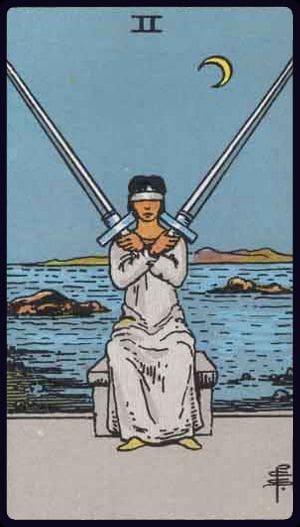
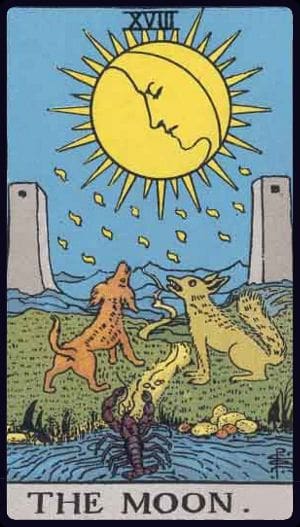
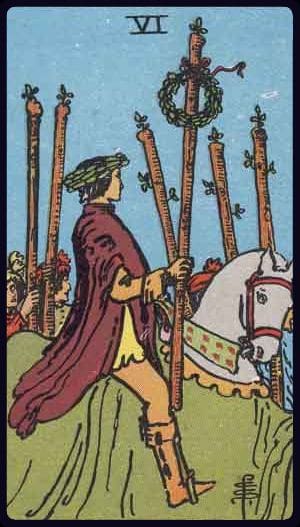
- Two of Swords
- The Moon
- Six of Wands
A shallow reading would define each card and stop there.
A better reading sounds more like this: the difficulty may not come from lack of options, but from uncertainty about what to trust. Two of Swords points to stalemate or avoidance. The Moon adds emotional fog, projection, or incomplete visibility. Six of Wands suggests a desire to make the “right” choice in a way that also feels validating or impressive. Taken together, the spread suggests that the pressure to feel certain and to come out looking successful may be making the decision harder than it needs to be.
That is the difference between listing meanings and actually reading tarot.
A useful test: After interpreting a spread, ask whether you could say its message in two or three clear sentences. If not, you may still be collecting meanings instead of synthesizing them.
A simple step-by-step tarot reading method for beginners
Here is a method that works well when you are learning.
1. Ask one clear question
Keep it specific enough to be real, but open enough to allow insight.
2. Choose a simple spread
One card or three cards is enough.
3. Pull the cards and write them down
Writing slows you down. That matters. It keeps you from rushing into the first convenient interpretation.
4. Look up the baseline meanings
There is no prize for pretending you do not need the guidebook.
5. Interpret each card in context
Ask what the card means here, in this position, for this question.
6. Pull the reading together
What pattern, tension, or perspective is the spread showing?
7. End with one grounded takeaway
Ask yourself: what is the most useful thing I can notice, do, or rethink after this reading?
That final step keeps tarot anchored in life rather than floating off into abstraction.
Three examples of how tarot interpretation works in practice
A work decision
Question: What am I not seeing about why I keep delaying this application?
Cards:
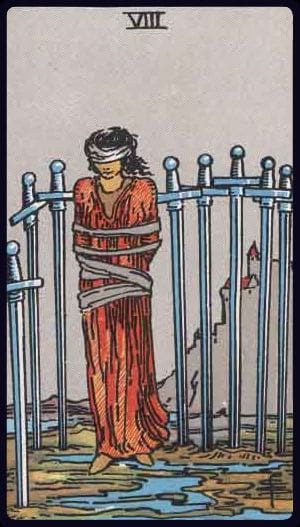
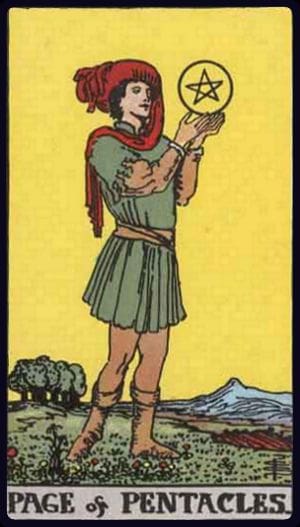
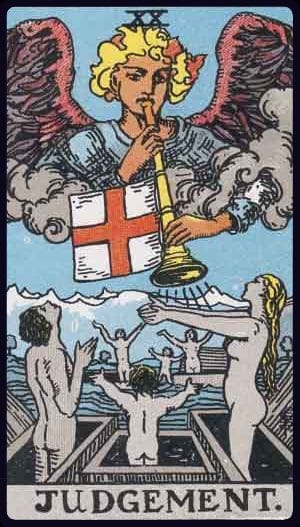
- Eight of Swords
- Page of Pentacles
- Judgment
Interpretation: This does not look like laziness. It looks more like a restrictive story about what the application means. Eight of Swords suggests mental trapping or self-limiting assumptions. Page of Pentacles points to a modest, practical next step rather than some huge performance. Judgment adds the sense that an older version of self may need to be outgrown.
Useful takeaway: stop treating the application like a verdict on your worth. Treat it like one concrete move.
A relationship conversation
Question: What is making this conversation harder than it needs to be?
Cards:
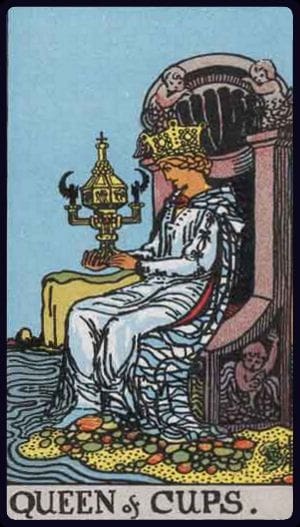
- Queen of Cups
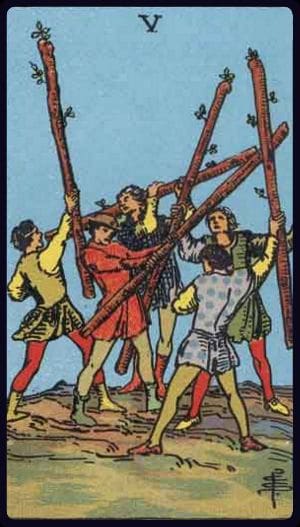
- Five of Wands
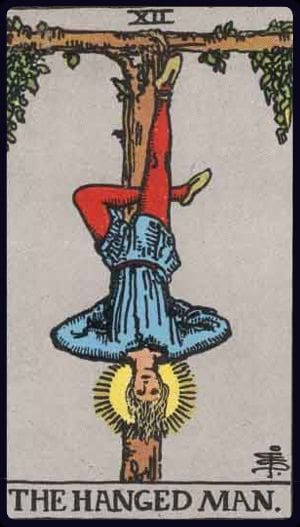
- The Hanged Man
Interpretation: There is real feeling here, but it may be getting tangled in defensiveness, competing agendas, or reactive energy. The Hanged Man suggests that progress may come from pausing, re-seeing the dynamic, or giving up the urge to control the frame of the conversation.
Useful takeaway: go in trying to understand the pattern, not to win the scene.
A daily card pull
Question: What should I pay attention to today?
Card:
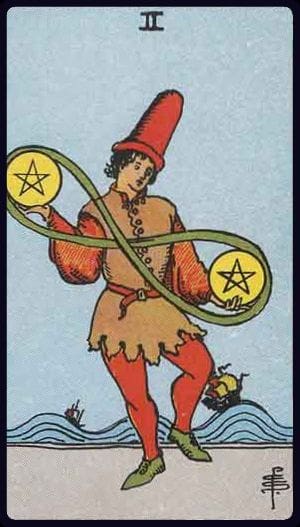
- Two of Pentacles
Interpretation: Today is likely to be shaped by rhythm, pacing, and competing demands. The card does not have to mean chaos. More often, it points to the need for flexibility and better handling of movement.
Useful takeaway: simplify before the day starts scattering your attention.
Why tarot can feel accurate even when it is symbolic

This question matters, especially for beginners.
Tarot can feel accurate because symbols are good at drawing attention to patterns, tensions, and emotions that are already present but not yet fully articulated. That does not make the experience fake. It means the mechanism is often more psychological than magical.
Ethan Kross’s work on self-distancing helps explain part of this. When people step back slightly from their own experience, they often think more clearly and react less impulsively. Tarot can create that kind of distance. Instead of staring straight at your problem, you respond to an image, a symbol, a structure. That shift can make reflection easier.
Susan David’s work on emotional granularity is relevant too. When people name emotions more precisely, they usually respond more wisely. Tarot often helps move experience out of blur. Instead of “I feel off,” the reading helps you notice, “I feel disappointed, conflicted, defensive, and rushed.” That is a much more workable level of clarity.
The cards may not hand you truth in some final form. What they often do is sharpen perception.
What this means in practice: A strong reading often feels accurate not because it predicts something dramatic, but because it names the real tension more clearly than you had named it before.
That same idea is at the heart of Tarot Told Me — a reflective app for uncertain moments, built around symbolic card readings. It is not about certainty. It is about slowing down, asking better questions, and seeing your own thoughts more clearly.Common mistakes beginners make when reading tarot
Asking questions that are too vague
If the question is foggy, the reading usually will be too.
Pulling too many cards
This is one of the fastest ways to lose clarity. Beginners often think more cards will produce a stronger answer. Usually they just produce more interpretive noise.
Treating the guidebook like either absolute law or useless fluff
Neither approach helps. The guidebook gives you a starting point. The real work is in applying the meaning to the actual reading.
Forcing the reading to confirm what you want
This is easy to do, especially when you want reassurance. But once you start bending every card toward your preferred answer, the reading stops being useful.
Ignoring the spread positions
A card in the challenge position is not the same as a card in the advice position. Position changes meaning.
Expecting certainty from a symbolic system
This expectation quietly distorts a lot of readings. Tarot is much better at perspective than at certainty.
Common correction: If a reading feels muddy, do not immediately pull more cards. First check the question, the spread size, and whether you actually combined the cards into one message.
How to get better at reading tarot over time
You do not get better by memorizing faster. You get better by reflecting more honestly.
A tarot journal is one of the simplest ways to improve. Write down the question, the cards, your first interpretation, and what later felt true, false, incomplete, or sharper in hindsight. Over time, you begin to notice patterns in your own reading style.
This is where reflective practice becomes more than a nice phrase. Donald Schön argued that people get better in uncertain situations by thinking about what they are doing while doing it, and by revisiting experience afterward. Tarot works that way too. You read, reflect, review, and slowly get less mechanical.
Writing can help here as well. Pennebaker’s research supports the idea that putting thoughts into language helps structure emotional experience. Even a short note before a spread and a short summary after it can make the reading clearer and more grounded.
How to use tarot without becoming dependent on it
There is a healthy way to use tarot and an unhealthy way.
Helpful use sounds like this: this reading gave me a better question. Or: this spread helped me notice the pattern I was avoiding.
Unhelpful use sounds like this: I cannot decide until I pull again. Or: I need the cards to tell me what will happen so I can calm down.
That distinction matters. Tarot becomes less useful when it starts replacing judgment, boundaries, or reality-testing.
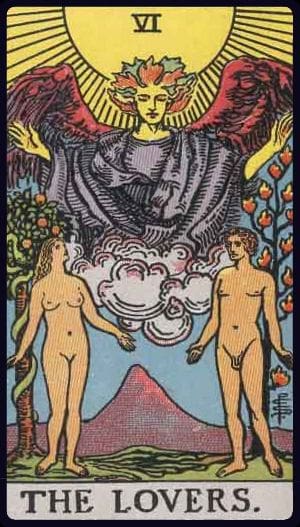
A grounded tarot practice helps you think. It should not make you less capable of making decisions without it.
This is also where narrower topics become useful for deeper reading later: how to ask better tarot questions, how to journal after a spread, how to read reversals, how to choose a beginner deck, how to understand Major Arcana and Minor Arcana, and how to use one-card pulls well. Those are all natural next steps once the basic reading process starts to click.
Beginner mini-guide: what to do the next time you pull cards
Use this simple sequence.
Ask
Choose one real question.
Pull
Use one to three cards.
Anchor
Check the baseline meanings.
Connect
Interpret each card through the question and the position.
Synthesize
Write two or three sentences about the overall pattern.
Apply
End with one practical takeaway.
That is enough. You do not need a dramatic reading. You need one that helps.
Final thoughts on how to read tarot cards

Learning how to read tarot cards becomes much easier once you stop treating interpretation like a secret code.
The goal is not to sound mystical. It is not to produce certainty on command. It is to look at a situation with more honesty, structure, and perspective.
For most beginners, that shift changes everything. The cards become less intimidating. The meanings become less rigid. The reading starts to feel less like a test and more like a way of thinking clearly with symbols.
That is when tarot begins to make sense. Not when it promises perfect answers, but when it helps you see better questions, clearer patterns, and more truthful next steps.
FAQ
Beginners usually do best with a simple spread, one clear question, and a guidebook nearby. Start with one to three cards, learn the baseline meanings, and then interpret the cards in relation to the question and the spread positions.
No. Memorization helps over time, but it is not the main skill. What matters more is learning how to connect a card’s core meaning to the actual situation you are reading about.
A three-card spread is usually the best place to start. It gives enough structure to create a meaningful reading without overwhelming you with too many details.
Some people read tarot that way, but for beginners it is usually more useful to approach tarot as a reflective tool. It can help you clarify dynamics, notice patterns, and think more carefully about what is happening.
First, check whether your question was too vague or your spread was too large. Then look at whether you interpreted the cards together or only one by one. If needed, write the reading down and come back to it later.
Not necessarily. A simple daily pull can be helpful, especially if you use it for reflection or journaling. It becomes less helpful when repeated readings turn into reassurance-seeking or avoidance.
Researchers and ideas behind this article
James W. Pennebaker — expressive writing and emotional processing
Putting thoughts and feelings into language can help people organize emotional experience and reflect more clearly.
Source: James W. Pennebaker — UT Austin
Donald A. Schön — reflective practice
Framing and reframing a situation is part of how people think through uncertainty in practice.
Source: The Reflective Practitioner — Basic Books
Amos Tversky and Daniel Kahneman — framing
The way a problem is framed changes how people interpret it and which options become psychologically visible.
Source: “The Framing of Decisions and the Psychology of Choice” (PDF)
Ethan Kross — self-distancing
Creating a little psychological distance from a difficult experience can improve reflection and reduce emotional overload.
Source: “Self-Distancing: Theory, Research, and Current Directions” (PDF
Susan David — emotional granularity
When people name emotions more precisely, they usually respond with more clarity and less autopilot reaction.
Source: Emotional Granularity Checklists — Susan David