Estimated reading time: 16 minutes
Table of contents
- How to Ask Tarot Questions That Lead to Better Insight
- The question shapes the reading before the reading even begins
- Why so many tarot questions fall flat
- What tarot is good at, and what it handles poorly
- What makes a tarot question worth asking
- A quick way to tell whether your question is too weak or too strong
- Five kinds of questions that tend to lead somewhere real
- Twenty tarot questions to ask when you feel stuck
- A real-life example: the reading changed when the question changed
- How to rewrite a vague or anxious tarot question
- A short guide you can use before any reading
- Why writing the question down helps more than people expect
- The most honest question is usually better than the most impressive one
- The point is not certainty. The point is recognition
- FAQ
- Researchers and ideas behind this article
Key Takeaways
- Weak tarot questions often arise from urgency, seeking certainty.
- Instead, focus on questions that promote reflection and understanding of your emotions.
- Use clearer prompts that connect to real situations and invite discovery.
- Strong questions should aim for insight rather than just a yes or no answer.
- Consider the specific nature of your question to enhance the tarot reading experience.
How to Ask Tarot Questions That Lead to Better Insight
A lot of disappointing tarot readings go wrong before the cards even hit the table.
In most cases, the problem is not the deck, the spread, or the fact that “nothing came through.”
Instead, it starts with the question.
People often turn to tarot when they feel emotionally crowded: too many thoughts, too much uncertainty, and not enough clarity. As a result, the first question that appears is often urgent, narrow, and loaded with hope or fear.
Will this work out?
Will they come back?
Am I making the right choice?
Is this a sign?
At first glance, those questions are completely understandable. Even so, they are often the ones most likely to produce a reading that feels vague, frustrating, or oddly repetitive.
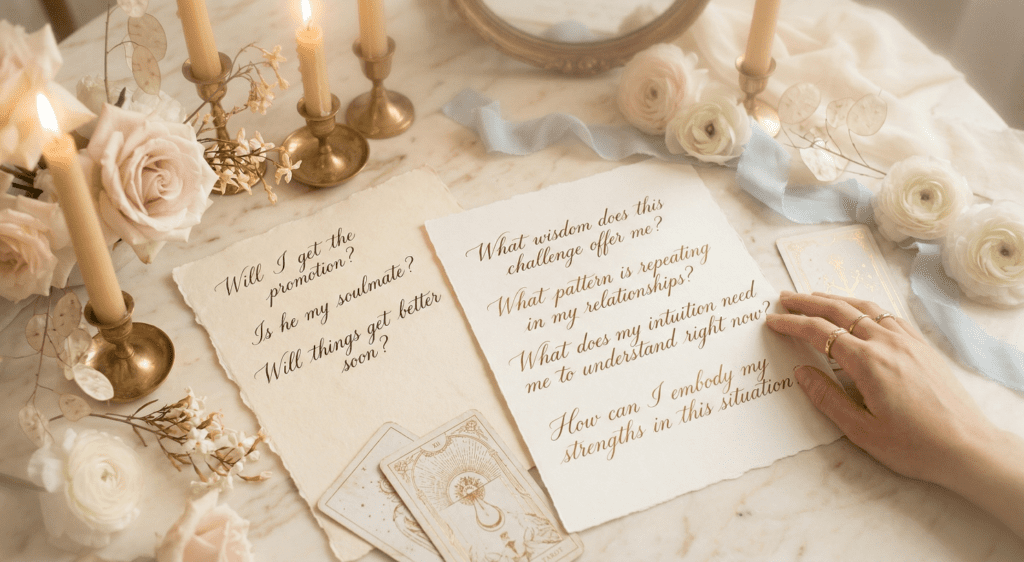
That is not because tarot failed. Rather, the question was trying to do the wrong job.
Tarot becomes far more useful when it is used for reflection instead of forcing certainty. In that form, a strong question does not demand a verdict from the cards. Instead, it helps you see the situation with more honesty, more detail, and a little less panic.
In this article, you will learn four things: how to stop asking weak yes-or-no questions, how to turn anxiety into a clearer prompt, what tarot is actually good at, and which kinds of questions lead to insight rather than empty suspense.
A weak tarot question asks the cards to decide.
A strong tarot question helps the reader see.
The question shapes the reading before the reading even begins
A tarot question is not just an opening line. In practice, it acts as the frame.
Because of that, it determines what kind of reading becomes possible. It shapes what your attention notices, what it ignores, and even what kind of meaning you are ready to find.
That idea is not mystical. In fact, psychologists Amos Tversky and Daniel Kahneman showed that the way a problem is framed changes how people interpret it and what options they can imagine. In plain English, wording is never neutral.
Look at the difference here:
Will I get the job?
Now compare it to this:
What do I need to understand about how I am approaching this opportunity?
The first question puts you in the position of someone waiting for a verdict, whereas the second pulls you back inside the situation. As a result, the reading can suddenly speak to confidence, fear, preparation, timing, self-sabotage, unrealistic expectations, or the part of you that already suspects the answer.
In other words, that is a very different kind of usefulness.
Donald Schön, writing about reflective practice, described how people deal with uncertain situations by framing and reframing the problem rather than simply applying a fixed answer. In a similar way, a better question does more than improve the reading. It changes what you are actually trying to understand.
Good questions do not simply request information. They shape perception.
Why so many tarot questions fall flat
Weak questions are rarely weak because they are badly phrased. More often, they come from urgency.
Maybe you want certainty. Maybe you want relief. Sometimes you want a yes or no. Often, you just want the discomfort to end.
That is why questions like these rarely lead anywhere interesting:Will I fail?
Is this person the one?
Will everything be okay?
Should I leave right now?
On the surface, these questions feel direct. In reality, though, they flatten a richer emotional situation into a narrow test.
“Will I fail?” may actually mean: I am terrified of rejection.
“Is this person the one?” may mean: I do not trust what I already see.
“Will everything be okay?” usually means: I do not know how to live with uncertainty right now.
Research on intolerance of uncertainty helps explain why this happens. When people feel overwhelmed by ambiguity, they often become more driven to seek immediate closure. As a result, that pressure can make a question smaller, tighter, and less useful.
So the issue is not that anxious questions are foolish. Instead, they are often too cramped to let real insight through.
The first question that comes to mind is not always the real question.
Sometimes it is just the fastest route your anxiety could find.
What tarot is good at, and what it handles poorly
This is where a lot of confusion starts.
Tarot can be genuinely useful, but only if you ask it to do the kind of work it actually does well.
Tarot is usually good at:
- clarifying emotional dynamics
- revealing patterns
- helping you reflect before a decision
- surfacing blind spots
- turning vague feelings into something more visible
- helping you slow down and ask better questions
Tarot is usually weak at:
- delivering exact predictions on demand
- giving certainty about another person’s inner world
- removing ambiguity completely
- making decisions for you
- acting like an objective machine for yes-or-no truth
That distinction matters. A lot of weak questions fail because they are trying to force tarot into the role of fortune-teller, judge, or emotional painkiller.

Tarot is usually more helpful when the question sounds like:
What do I need to understand?
What am I not seeing clearly?
What pattern is active here?
What is my role in this situation?
And less helpful when the question sounds like:
Tell me exactly what will happen.
Tell me what this person really thinks.
Tell me whether everything will be okay.
That does not make tarot smaller. It makes it more honest.
What makes a tarot question worth asking
A useful tarot question does not need to sound poetic. Nor does it need mystical language or the performance of wisdom.
Instead, it simply needs to open the right door.
In practice, the strongest questions tend to do five things well. First, they aim for understanding instead of guarantees. At the same time, they stay connected to a real situation. They also leave room for complexity, include your role in what is happening, and invite discovery rather than trying to control the outcome.
So instead of this:
Will this relationship last?
you get something more useful like this:
What dynamic in this relationship needs to be seen more clearly?
Instead of this:
Will moving make me happier?
you ask:
What hopes, fears, or expectations am I projecting onto the idea of moving?
Notice what happens there. The question becomes more open, but also more precise. It stops asking for a pronouncement and starts asking for understanding.
That is usually where the reading begins to breathe.
A quick way to tell whether your question is too weak or too strong
| If your question sounds like this | It usually means | A stronger version sounds like this |
|---|---|---|
| Will this work out? | I want certainty fast. | What is shaping this situation right now? |
| Will they come back? | I want relief from emotional suspense. | What do I need to understand about this connection and my attachment to it? |
| Should I quit? | I feel trapped and want a clean escape. | What is making this situation feel unbearable, and what do I need to see before deciding? |
| Is this a sign? | I want outside confirmation. | What am I hoping this moment will confirm for me? |
| Will I be happy if I move? | I am projecting hope onto one big decision. | What am I expecting this move to change emotionally? |
| Does this relationship have a future? | I want certainty about someone else. | What truth about this relationship needs to be seen more clearly? |
| Am I making the right choice? | I am afraid of responsibility. | What do I need to understand before I choose? |
This is the core shift. Move away from prediction. Move toward perception.
Five kinds of questions that tend to lead somewhere real
Not every situation needs the same kind of question. Sometimes you need clarity. Sometimes you need to catch a pattern in the act. Sometimes you need to admit that the problem is not confusion at all. It is conflict.
Questions for clarity
These help when everything feels muddy.
What am I not fully acknowledging about this situation?
What is the central issue here?
What am I overlooking right now?
These questions do not demand certainty. They ask for a sharper view.
Questions for patterns
These are for situations that keep repeating with different clothes on.
What pattern keeps repeating here?
Why do I keep returning to this kind of situation?
What am I reenacting without realizing it?
Tarot is often strongest here, not because it reveals secret destiny, but because symbols can catch emotional repetition faster than ordinary language sometimes can.
Questions for inner conflict
Sometimes the issue is not outside you. It is that two parts of you want different things.
What part of me wants this, and what part resists it?
What am I torn between here?
What desire is in conflict with what fear?
This kind of question usually leads to a more honest reading because it stops pretending you are one tidy, unified person with one clean motive.
Questions for decisions
This is one of tarot’s best uses, as long as you are not asking the cards to take responsibility for your life.
What do I need to understand before making this choice?
What factors am I underestimating?
What would help me respond more wisely here?
The goal is not to outsource the decision. The goal is to see the landscape more clearly.
Questions for growth
These help when a situation feels painful, sticky, or strangely meaningful.
What is this experience asking me to learn about myself?
What kind of growth is possible here?
What is this moment revealing about my needs, limits, or values?
Jerome Bruner’s work on narrative and Dan McAdams’ work on narrative identity both support a useful idea here: people do not understand life through facts alone. They also understand it through interpretation, story, and the evolving sense of who they are. A strong tarot question often works because it helps you notice the story you are currently living inside.

Sometimes a reading feels powerful not because it predicts anything, but because it names the story you have been acting out without fully noticing it.
Twenty tarot questions to ask when you feel stuck
Sometimes the hardest part is simply knowing where to begin. These questions give you better starting points than the usual yes-or-no spiral.
For emotional clarity
- What am I feeling that I have not fully named yet?
- What am I not seeing clearly about this situation?
- What is the real source of my unease here?
- What am I confusing, avoiding, or blending together?
- What truth feels close, but hard to admit?
For relationships
- What dynamic in this relationship needs to be seen more clearly?
- What am I bringing into this connection?
- What am I idealizing, minimizing, or excusing?
- What does this relationship reveal about my needs or boundaries?
- What emotional pattern am I repeating here?
For work and career
- What is draining me most in this situation?
- What am I undervaluing in myself?
- What am I hoping this job change will solve?
- What needs to be true for this path to feel sustainable?
- What should I understand before making my next move?
For decisions
- What factors am I underestimating?
- What am I most afraid will happen if I choose?
- What part of this decision is practical, and what part is emotional?
- What am I trying to control right now?
- What would wise action look like here?
For personal growth
- What is this experience trying to teach me about myself?
- Where am I being asked to mature, soften, or become more honest?
- What pattern is ready to end?
- What belief about myself is shaping this moment?
- What kind of change am I resisting?
This kind of list helps the article function as a real reference page, not just a reflection piece.
A real-life example: the reading changed when the question changed
Imagine someone called Maya. She is 31, exhausted at work, and quietly obsessed with the idea of moving to another city. For weeks, she keeps asking the same tarot question:
Should I move?
Each reading leaves her frustrated. The cards feel vague. Nothing lands. She keeps pulling more cards, hoping one spread will finally tell her what to do.
Then she changes the question.
Instead of asking Should I move?, she asks:
What am I expecting this move to solve emotionally?
Now the reading changes.
Instead of circling around yes-or-no tension, it starts pointing to burnout, loneliness, fantasy, and the pressure she has put on one external decision to fix several internal problems at once. The move may still be right. But now the reading is no longer pretending the city itself is the answer. It is showing her what she is carrying into the decision.
That is a much better use of tarot.
The insight is not “move” or “don’t move.” The insight is: I am not only asking about geography. I am asking about escape, hope, and the life I want to feel inside.
That kind of shift is what good questions make possible.
How to rewrite a vague or anxious tarot question
If your question sounds like it came from panic, rewrite it until it sounds like it came from curiosity.
Here are a few examples.
Example 1
Weak: Will I be happy if I move?
Better: What am I hoping this move will solve?
Best: What do I need to understand about my expectations, fears, and motives before deciding whether to move?
Example 2
Weak: Does he love me?
Better: What is the emotional truth of this connection?
Best: What do I need to see clearly about this relationship, including what I may be avoiding?
Example 3
Weak: Will this work out?
Better: What is shaping this situation right now?
Best: What am I overlooking that would help me respond to this more wisely?
Example 4
Weak: Should I quit?
Better: What is making this situation feel unbearable?
Best: What do I need to understand about my limits, needs, and next step before deciding whether to leave?
Example 5
Weak: Is this person right for me?
Better: What truth about this relationship am I resisting?
Best: What do I need to understand about this connection, my needs, and my pattern of attachment?
The pattern is simple. Move away from prediction. Move toward perception.
A short guide you can use before any reading
When people say they do not know what to ask, the problem is usually not lack of words. It is that the situation is still emotionally tangled.

Before you pull any cards, take two minutes and do this.
1. Name the pressure
Finish this sentence:
What feels most emotionally charged right now is…
2. Separate the event from the feeling
Write these two lines:
What happened is…
What I am feeling about it is…
That gap matters. It often shows whether you are reacting to facts, fears, or assumptions.
3. Catch the hidden agenda
Ask yourself:
What answer am I secretly hoping to get?
This is one of the most useful prompts in tarot. It reveals where you are already leaning, what you want permission for, and what you may not want to hear.
4. Rewrite toward understanding
Take your first draft question and replace prediction with inquiry.
Instead of:
Will X happen?
try:
What do I need to understand about X?
Or:
What am I not seeing clearly about X?
Or:
What is my role in this situation?
5. Check whether the question is ready
Your question is probably strong enough if:
- it is about understanding, not forcing certainty
- it names a real situation
- it includes your role, feelings, or assumptions
- it leaves room for complexity
- it could lead to reflection, not just reassurance
If it only demands certainty, it probably still needs work.
Why writing the question down helps more than people expect
It is easy to treat the question as a quick pre-reading step. In reality, however, the question is part of the reading itself.
James Pennebaker’s work on expressive writing helps explain why. When thoughts and feelings are put into words, people can often structure emotional experience more clearly and reflect on it more effectively. As a result, writing the question down is not just preparation. It is already a way of turning emotion into something more workable.
By contrast, a question that stays in your head often remains cloudy. Once it is on paper, though, it becomes visible. You can test it, rewrite it, notice its assumptions, and see whether it is asking for understanding or simply begging for relief.
That shift makes a real difference.
The most honest question is usually better than the most impressive one
A lot of people try to ask tarot questions that sound elevated. They want the question to feel profound, symbolic, maybe even a little dramatic.
But the questions that actually lead somewhere are often plainer than that.
Not:
What archetypal transformation is the universe initiating me into?
But:
Why am I so afraid of choosing wrong?
Not:
What destiny is unfolding here?
But:
What am I trying to control because uncertainty feels unbearable?
Not:
What sacred lesson am I meant to receive?
But:
What do I already know that I do not want to admit?
These questions may sound less glamorous. They are usually much more alive.
That is because symbols do better work when they are given something real to touch.
The best tarot questions are not the most mystical ones.
They are the most honest ones.
The point is not certainty. The point is recognition
A weak tarot question asks the cards to decide.
A strong tarot question helps the reader see.
That is the real difference.
When the question becomes more specific, more honest, and less obsessed with controlling the future, tarot becomes more useful. Not because it turns into a flawless prediction system, but because it becomes what it may have been good at all along: a way to pause, notice, interpret, and reflect.
FAQ
It can, but that is usually not where tarot is most useful. Yes-or-no questions tend to flatten a more complex situation into a simple verdict. In many cases, tarot works better when the question invites reflection, context, and emotional honesty.
A good beginner question is usually open, clear, and grounded in a real situation. For example, instead of asking Will this work out?, it is often more useful to ask What do I need to understand about this situation right now?
Questions that demand total certainty, try to control another person’s inner world, or ask the cards to make decisions for you are usually less helpful. For example, What does this person secretly think? or Tell me exactly what will happen often lead to weaker readings.
In many cases, the reading feels vague because the question is too broad, too anxious, or too focused on prediction. When the question becomes more specific and reflective, the reading often becomes more useful too.
Yes, but usually not by giving a clean command. Instead, tarot can help you notice blind spots, emotional patterns, hidden fears, and the assumptions shaping your choice. That makes it more useful for reflection than for outsourcing responsibility.
That is also the idea behind Tarot Told Me — a reflective app for uncertain moments, powered by symbolic card readings. Not a machine for certainty, but a place to slow down, ask better questions, and come back to your own thoughts with more clarity.Researchers and ideas behind this article
Donald Schön — reflective practice
“Framing and reframing the problem is part of how people think through uncertain situations.”
Source: The Reflective Practitioner
Amos Tversky and Daniel Kahneman — framing
“The way a problem is framed changes how people interpret it and what choices they can see.”
Source: The Framing of Decisions and the Psychology of Choice
Dan McAdams — narrative identity
“People make sense of themselves through an internal life story that links past, present, and imagined future.”
Source: Dan McAdams — Northwestern Psychology profile and Narrative Identity: What Is It? What Does It Do? How Do You Measure It?
James Pennebaker — expressive writing
“Putting thoughts and feelings into words can help structure emotional experience.”
Source: Expressive Writing in Psychological Science
Michel Dugas — intolerance of uncertainty
“Anxiety often intensifies the need to resolve uncertainty quickly.”
Source: Review article on intolerance of uncertainty in anxiety disorders
Jerome Bruner — narrative meaning-making
“People understand life not only through facts, but through interpretation and narrative form.”
Source: Life as Narrative