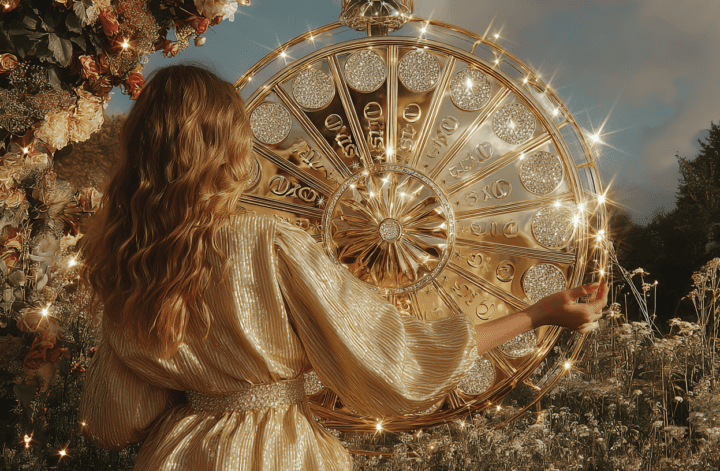
The Fool tarot archetype begins at the edge of certainty.
In most decks, he stands at the start of a path, carrying almost nothing. A small animal follows him. The sky is open. The cliff, if there is one, is close enough to make the viewer nervous. The Fool does not look nervous. That is part of the problem, and part of his charm.
He is card zero: before the sequence, inside the sequence, outside it. He has not yet become skilled, wounded, disciplined, disillusioned, wise, or complete. He is the psyche before experience has done its work.
For that reason, The Fool is one of the cleanest cards to read psychologically. You do not need to believe he predicts a new beginning. You only need to ask what happens inside you when you see someone standing so lightly at the edge.
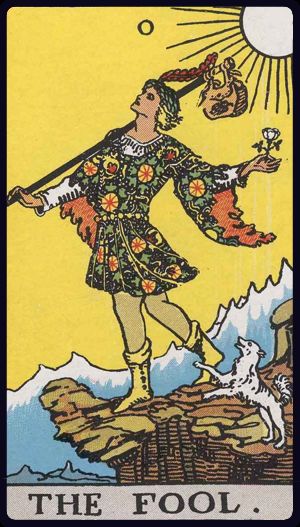
The Fool tarot archetype represents beginnings, innocence, risk, instinct, openness, psychic potential, and the unformed self before experience has shaped it. In a Jungian reading, The Fool can be understood as an image of the psyche at the start of a journey toward consciousness, integration, and individuation.
The Fool before Jung
Carl Jung did not invent tarot, and he did not leave behind a complete tarot system. The better claim is quieter: Jungian psychology gives us useful language for symbolic images.
Archetype. Shadow. Persona. Active imagination. Individuation.
These words help explain why a small illustrated card can feel larger than the situation that produced the reading.
In Jungian psychology, archetypes are symbolic patterns connected to the collective unconscious. The APA Dictionary of Psychology defines a Jungian archetype as a symbol representing aspects of the psyche that come from the accumulated experience of humankind.
That is why The Fool feels older than any single question.
He is the beginner, the wanderer, the holy innocent, the naïve traveler, the ridiculous outsider, the one who leaves before he knows what leaving will cost. He appears in myths, fairy tales, comedies, spiritual stories, and ordinary life. Sometimes he is blessed because he does not know enough to be afraid. Sometimes he is in danger for the same reason.
A beginner’s way to read The Fool
A beginner does not need to start with Jung. Start with the image.
Ask: Where am I at the beginning of something?
Then look at The Fool for one minute before opening a guidebook. Notice the first feeling that appears. It may be excitement, fear, irritation, envy, tenderness, or judgment. That first reaction is part of the reading.
If your first thought is “he looks free,” the card may be showing you a hunger for movement. If your first thought is “he looks careless,” the card may be showing you your relationship to risk. If your first thought is “I would never do that,” the card may be touching the part of you that survives by staying prepared.
The point is not to decide whether The Fool is good or bad. The point is to notice what kind of beginning you can tolerate.
A useful sentence might be:
The beginning I am facing is…
The risk I need to respect is…
The small step I can take is…
This keeps the card in the realm of reflection. The Fool does not tell you to leap. He helps you examine your relationship to leaping.
The Fool as psychic potential
In a Jungian frame, The Fool can be read as the psyche before it hardens into a fixed identity.
He has not yet become The Emperor, with structure and law. He has not yet become The Hermit, with solitude and knowledge. He has not yet become The Tower, with collapse and revelation. He has not yet learned what will later be called strength, judgment, restraint, grief, or wisdom.
He is potential.
This is why many Jungian tarot writers place The Fool at the beginning of an archetypal journey. Sallie Nichols’ Jung and Tarot: An Archetypal Journey is one of the best-known books connecting tarot with Jungian psychology; one of its chapters, “The Fool in Tarot and in Us,” frames the card as a psychological figure, not only a divinatory symbol.
The phrase “in us” matters.
The Fool is not merely an illustrated character. He is the part of the psyche that has not yet been trained into caution, competence, performance, and fear of looking stupid. Sometimes that part is dangerous. Sometimes it is exactly what restores life.
The Fool and individuation
Jung used individuation to describe the gradual development of a more integrated self: a movement toward wholeness, in which unconscious material is encountered rather than endlessly avoided.
The Fool is not the integrated self. He is not the wise ending of the journey.
He is the beginning of movement.
He enters before he understands the Magician’s skill, the High Priestess’s silence, the Emperor’s law, the Devil’s attachments, or the Tower’s collapse. He does not yet know what the journey will ask of him. If he did, he might never begin.
This is the psychological beauty of the card. No one starts a real inner journey fully prepared for it. The self that begins is never the self that finishes.
The Fool carries innocence, but innocence is unstable. It can become trust, curiosity, freedom, and courage. It can also become denial, recklessness, and refusal to look down.
A Jungian reading keeps both possibilities alive.
The Fool as the holy innocent
In fairy tales, the foolish character often survives because he does not know the correct way to fail.
He asks the wrong question. He trusts the strange helper. He wanders into the forbidden place. He misunderstands the rules that everyone else has mistaken for reality.
A Jungian reader might see in this figure the psyche’s need for renewal. The ego becomes clever, defended, identified with its achievements and explanations. Then The Fool appears: unreasonable, fresh, embarrassing, alive.
He does not care whether the old identity remains coherent.
He wants movement.
This can be the kindest interpretation of The Fool. He may appear when you are over-identified with being sensible. When caution has become a personality. When maturity has quietly turned into the refusal to begin anything that might make you look amateur.
The Fool asks a painful, useful question:
What would you try if you did not need to look like someone who already knows?
The Fool as trickster
The Fool also has a trickster edge.
He disrupts hierarchy because he does not fully respect it. He says what others avoid. He reveals the absurdity of the king, the expert, the institution, the polished life story, the five-year plan.
This is why The Fool is not only sweet.
He can be inconvenient.
Psychologically, he may appear when the personality has become too rigid. A person has a plan, a role, a respectable explanation, a public self, and then something in them wants to walk sideways out of the frame.
That does not mean every impulse is wisdom.
It means every rigid identity has a counterforce.
The Fool may be that counterforce. He asks where seriousness has become a defense, where competence has become a cage, where the need to be legible has started to cost too much.
The shadow side of The Fool
The Fool should not be turned into a motivational poster.
His shadow is easy to recognize: recklessness, avoidance, naïveté, refusal to prepare, mistaking impulse for freedom, leaving before learning the lesson, calling every consequence “adventure.”
A shallow reading says: jump.
A better reading asks: what kind of jump is this?
If The Fool appears in a reading about work, love, money, or a major life change, the useful questions are sober ones. What am I not seeing because the beginning feels exciting? Where am I romanticizing uncertainty? What preparation would make this risk cleaner? Am I moving toward life, or away from responsibility?
The Fool is not anti-responsibility.
He is pre-responsibility.
The task is to let his aliveness into the room without handing him the keys.
The Fool and the persona
In Jungian psychology, persona is the social face: the version of the self arranged for the world.
The Fool often irritates the persona.
The persona wants to look competent. The Fool is willing to look ridiculous. The persona wants a clean explanation. The Fool begins before the story is polished. The persona wants approval. The Fool wanders.
This makes The Fool useful when someone has become trapped inside a role: the reliable one, the clever one, the successful one, the calm one, the person who never needs help.
The question becomes:
What would I do if I were allowed to be a beginner again?
That question can be surprisingly emotional. Many people do not fear failure as much as they fear being seen at the beginning.
How to interpret The Fool as an archetype
A useful archetypal reading of The Fool has three layers: the beginning, the risk, and the attitude.
The beginning asks where something new, unformed, or unnamed is appearing.
The risk asks what is uncertain, exposed, or not fully prepared.
The attitude asks how you are meeting the beginning: with openness, denial, trust, avoidance, curiosity, panic, performance, or control.
For example:
Question: What part of me wants to begin?
Card: The Fool
First reaction: He looks free, but also careless.
Reflection: I want freedom, but I am afraid that wanting it makes me irresponsible.
Next step: Define one safe experiment instead of making a dramatic leap.
This is where The Fool becomes psychologically useful.
He does not say, “Quit your job.” He does not say, “Say yes.” He does not say, “The universe will catch you.”
He asks what your psyche does at the edge of the new.
The Tarot Told Me app is built for people who want tarot to feel like a reflection space, not a prediction machine. You can ask a question, pull a card, and save what tarot told you as a note to return to later.
Reflective prompts for The Fool
The best questions for The Fool are not grand. They are clean.
Where am I at the beginning of something?
What would I try if I were allowed to be new?
Where am I confusing caution with wisdom?
Where am I confusing impulse with freedom?
What part of me wants to leave the old story?
What risk needs more preparation?
What small experiment would honor The Fool without obeying him blindly?
What would become possible if I stopped needing to look ready?
Choose one question. Stay with it.
The Fool needs space around him. Too many questions turn the card into noise.
Suggested reading
— Tarot and Jung: Archetypes, Symbols, and Self-Reflection
— Tarot and Psychology: Why Cards Feel So Personal
— Can You Read Tarot for Yourself? What Beginners Should Know
FAQ
What is The Fool tarot archetype?
The Fool tarot archetype represents beginnings, innocence, risk, openness, psychic potential, and the part of the self that steps into experience before it fully understands the path.
How should beginners interpret The Fool?
Beginners can interpret The Fool by asking: “Where am I at the beginning of something?” The first reaction matters. Freedom, fear, irritation, or judgment can all point to how you relate to starting again.
What does The Fool mean in Jungian tarot?
In Jungian tarot, The Fool can be read as the unformed self, the holy innocent, the trickster, or the psychic potential that begins the journey toward individuation.
Is The Fool a positive card?
The Fool can be positive, but not automatically. It can suggest openness, trust, curiosity, and renewal. It can also point to recklessness, denial, or lack of preparation.
How is The Fool connected to individuation?
The Fool can be read as the figure who begins the individuation journey. He represents movement into experience before the self has become integrated, tested, or fully conscious.
Did Jung write about The Fool tarot card?
Jung did not create a full tarot system around The Fool. Later Jungian tarot writers used Jung’s ideas about archetypes, symbols, and individuation to read The Fool psychologically.