
The Magician tarot archetype begins where The Fool’s openness becomes directed attention.
The Fool steps toward the unknown with almost nothing. The Magician stands before a table with everything arranged in front of him. Wand, cup, sword, pentacle: the symbolic materials of action, feeling, thought, and matter. His hand points upward and downward, as if he is conducting a current between what is imagined and what can be made.
He is not yet wisdom. He is not yet mastery in the mature sense. He is the first thrilling, dangerous moment when the psyche discovers that it can do something.
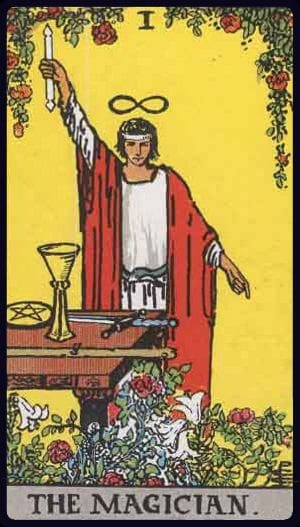
Definition: The Magician tarot archetype represents agency, will, skill, attention, manifestation, language, performance, and the ability to shape raw potential into action. In a Jungian reading, The Magician can be understood as the part of the psyche that learns to mediate between inner possibility and outer form.
The Magician after The Fool
The Fool is possibility before form.
The Magician is possibility with a hand on it.
This is why the card often feels electric. Something that was vague now has tools. Something that was only desire now has method. Something that was floating in the mind can be named, spoken, shaped, sold, performed, built, or begun.
In Jungian language, archetypes are symbolic patterns connected to the collective unconscious. The APA Dictionary of Psychology defines a Jungian archetype as a symbol representing aspects of the psyche that come from the accumulated experience of humankind.
The Magician is one of those patterns: the maker, the speaker, the mediator, the clever one, the person at the threshold between invisible and visible.
He knows that an idea is not enough.
He knows it needs gesture, language, timing, tools.
A beginner’s way to read The Magician
Start by looking at the table.
What has been placed there? What is available? What is missing? What has been ignored because you are still waiting to feel more ready?
A beginner-friendly question for The Magician is:
What resource am I not using?
Do not rush to interpret the card as success. The Magician is not always a promise that something will work. He is an invitation to inspect your relationship with agency.
Maybe you have the knowledge but are avoiding the first draft. Maybe you have the contact but are afraid to send the message. Maybe you have the skill but keep pretending you need one more course before you can begin.
The Magician often appears when the problem is no longer potential.
The Magician as will
In Jungian terms, The Magician can be read as the emergence of conscious will.
The Fool moves because life pulls him forward. The Magician moves because attention has gathered into intention.
He says: I can focus. I can choose. I can arrange the materials. I can make a sign, a sentence, a ritual, a product, an argument, a performance. I can cause something to appear where there was only possibility.
That is a psychologically significant moment.
Many people have desire without will. They want change, but their attention is scattered. They collect tools, options, advice, inspiration, and interpretations. The Magician asks what happens when all of that is placed on one table.
A Magician reading is rarely about having everything.
It is about using what is already there.
The Magician as mediator
The Magician stands between above and below, idea and matter, inner image and outer action.
That makes him a mediator figure.
He does not live entirely in the unconscious, like a dream image that never becomes speech. He also does not live entirely in the outer world, where everything must be practical, measurable, and already justified. He translates.
A feeling becomes a sentence.
A fantasy becomes a sketch.
An intuition becomes an experiment.
A private desire becomes a visible move.
This is why The Magician is so useful for reflective tarot. He shows the moment when inner material begins to take form.
The question is not “Will I manifest this?”
The better question is:
What wants to move from image into action?
Curious about the card? Read it two ways
On Tarot Told Me Instagram, you can start even if you are skeptical. We read cards in Skeptical Mode as prompts for reflection and in Mystical Mode as symbols with atmosphere, archetypes, and intuition.
The Magician as creator
Sallie Nichols, one of the best-known Jungian tarot writers, gives The Magician a chapter title that is wonderfully revealing: “The Magician: Creator and Trickster.” That pairing points to the card’s central tension.
The Magician creates, but creation is never innocent.
To create is to select. To select is to leave something out. To speak is to frame. To frame is to influence perception.
The Magician understands the power of arrangement. Put the same objects on a table in a different order and the story changes. Say the same truth with a different rhythm and people hear it differently. Turn a private idea into a public object and it begins to affect the world.
This is the beautiful side of The Magician.
He is the archetype of the first act: the beginning that is no longer only inner.
The Magician as trickster
The same talent can become manipulation.
The Magician knows how to direct attention, and attention is not neutral. He can clarify, but he can also distract. He can reveal, but he can also stage-manage. He can turn skill into art, or skill into control.
This is why the card should not be flattened into “you are powerful.”
A Jungian reading asks where the power is going.
Is The Magician using language to make something true enough to be shared, or to avoid a truth that would be simpler? Is he making reality more vivid, or more convenient? Is he creating, or performing creation?
The trickster side of The Magician is not automatically bad. Trickster energy can puncture stiffness, solve impossible problems, and find the side door where the official entrance is blocked.
But when The Magician is ungrounded, he can become all performance: cleverness without integrity, charisma without substance, tools without responsibility.
The shadow side of The Magician
The shadow of The Magician often looks impressive from the outside.
Overpromising.
Charm without follow-through.
Mistaking preparation for action.
Using language to blur rather than clarify.
Turning every relationship into an audience.
Collecting tools to avoid doing the work.
In Jungian psychology, the shadow refers to parts of the psyche that remain hidden, rejected, or unacceptable to the conscious ego.
With The Magician, shadow material may not look dark at first. It may look competent, dazzling, articulate.
That is what makes it easy to miss.
The reflective question is:
Where am I using skill to avoid honesty?
That question can be uncomfortable. It should be. The Magician is not only the card of “I can.” He is also the card of “what am I doing with the fact that I can?”
The Magician and the persona
The Magician is closely related to persona because he knows how to appear.
Persona, in Jungian psychology, is the public face a person presents to the outside world.
The Magician can build a persona beautifully: the expert, the founder, the reader, the artist, the strategist, the person who always has the right words.
There is nothing wrong with this. A persona helps us meet the world. It gives shape to work, identity, and social life.
The problem begins when the performance becomes too polished to let anything real interrupt it.
The Magician then asks:
What am I performing so well that I have started to believe it is the whole of me?
Want to try it with guidance?
Tarot Told Me on YouTube has guided tarot practices, meditations, and a live stream where you can do a three-card spread in real time. Use it when you want the card to become a calm reflective practice, not another thing to decode alone.
The Magician and individuation
Jung used individuation to describe the gradual development of a more integrated self: a process in which conscious and unconscious material become more fully related.
The Magician’s place in that process is early but essential.
The psyche cannot remain The Fool forever. At some point, potential must become form. The inner image must enter the world. The self must discover agency, language, and action.
But individuation is not the same as becoming effective.
That is the trap of The Magician.
You can become highly skilled and still be divided. You can speak beautifully and still not tell the truth. You can build impressive things and still avoid the question that matters.
A Jungian reading of The Magician asks not only “What can I make?” but “What wants to become conscious through what I am making?”
How to interpret The Magician as an archetype
A useful Magician reading begins with three questions.
What is on the table?
Where is my attention going?
What am I trying to bring into form?
The first question names your resources: skills, tools, time, contacts, money, language, energy, taste, experience.
The second question names your focus. Not what you claim to care about, but where attention actually goes.
The third question names the act: the email, the draft, the conversation, the sketch, the offer, the boundary, the experiment.
For example:
Question: What resource am I not using?
Card: The Magician
First reaction: He looks prepared, almost too prepared.
Reflection: I may already have enough to begin, but I am keeping my tools on the table because action would expose the work to judgment.
Next step: Make one rough version before looking for another resource.
The Magician is not asking you to become perfect.
He is asking what you can do with what is already in your hands.
Tarot Told Me note
The Tarot Told Me app is built for people who want tarot to feel like a reflection space, not a prediction machine. You can ask a question, pull a card, and save what tarot told you as a note to return to later.
Reflective prompts for The Magician
The cleanest Magician prompts are practical, almost annoyingly so.
What is already on my table?
What resource am I not using?
Where is my attention scattered?
What am I ready to bring into form?
Where am I performing competence instead of taking action?
What am I using language to clarify, and what am I using it to hide?
What small act would turn potential into reality?
What would skill look like with more integrity?
Choose one.
The Magician is already full of tools. He does not need a crowded spread.
Keep The Magician grounded
The Magician is seductive because he makes agency feel elegant.
A raised hand. A prepared table. A sense that the invisible can be invited into form.
But grounded agency is less glamorous than the card. It often looks like sending the email, naming the offer, making the prototype, editing the sentence, setting the boundary, booking the appointment, or telling the truth without decorating it.
The Magician opens the channel between idea and action.
You still have to do the action.
When tarot is not therapy
Tarot can support journaling, self-reflection, symbolic thinking, and emotional awareness. It is not therapy, diagnosis, medical advice, legal advice, financial advice, or crisis support.
Jungian language can make a reading feel deep, but depth is not the same as care. If a reading increases panic, obsession, fear, or the urge to keep checking, stop. Reach for something steadier: a trusted person, rest, grounding, or a qualified professional.
Tarot can be part of a reflective practice.
It should not become the whole support system.
Suggested reading
— How to Read Tarot Cards: A Beginner-Friendly Guide to Interpretation That Actually Makes Sense
— The World Tarot Meaning: Completion, Fulfillment & Integration
— The Sun Tarot Meaning: Joy, Success & Vitality
FAQ
What is The Magician tarot archetype?
The Magician tarot archetype represents agency, will, skill, attention, creation, performance, and the ability to turn raw potential into action.
How should beginners interpret The Magician?
Beginners can interpret The Magician by asking, “What resource am I not using?” Look at the tools on the card, then notice what skill, knowledge, or opportunity is already available in your life.
What does The Magician mean in Jungian tarot?
In Jungian tarot, The Magician can be read as the creator, mediator, trickster, or conscious will that translates inner possibility into outer form.
Is The Magician a positive card?
The Magician can be positive, but not automatically. It can suggest skill, focus, and agency, but it can also point to manipulation, performance, scattered attention, or cleverness without integrity.
How is The Magician connected to individuation?
The Magician can represent an early stage of individuation where the psyche discovers agency and begins to bring unconscious material into conscious form through language, action, and creation.
Did Jung write about The Magician tarot card?
Jung did not create a tarot system around The Magician. Later Jungian tarot writers, including Sallie Nichols, used Jung’s ideas about archetypes, symbols, active imagination, and individuation to interpret The Magician psychologically.