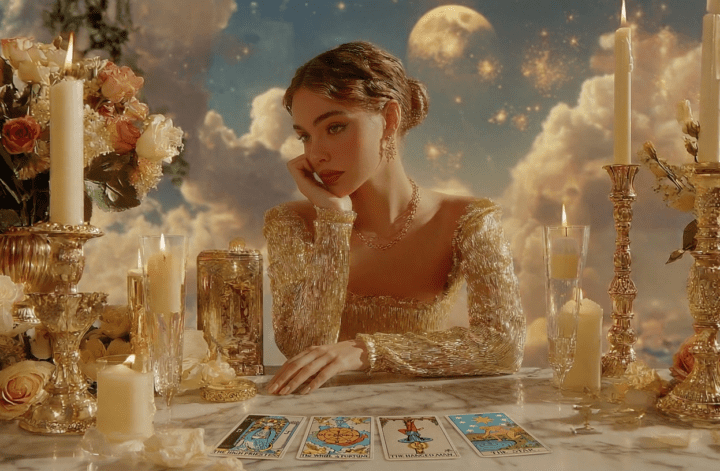
The High Priestess tarot archetype begins where action becomes too loud.
After The Magician, with his table, tools, language, gesture, and will, The High Priestess is almost suspiciously still. She does not perform. She does not explain. She does not rush to make the invisible useful. She sits at the threshold and keeps her own counsel.
In many decks, she is placed between two pillars. A veil hangs behind her. Water often appears nearby or implied in the image. She holds a scroll or book, but it is not fully open to us. The card feels like a room where something is known, but not yet ready to be spoken.
For a Jungian reader, that is exactly why she matters. The High Priestess is not simply “intuition.” She is the psyche’s relationship with hidden knowledge: dream, symbol, memory, silence, inner timing, and the unconscious before it becomes language.
Definition: The High Priestess tarot archetype represents intuition, silence, inner knowing, mystery, receptivity, dreamlike perception, and the threshold between conscious thought and unconscious material. In a Jungian reading, she can be understood as the figure who guards what is not yet ready to be rationalized.
The High Priestess after The Magician
The Magician wants to bring something into form.
The High Priestess asks what should not be forced into form too soon.
This is the first correction after the thrill of agency. The Magician discovers that he can act. The High Priestess reminds him that not everything valuable arrives by effort. Some things need listening. Some need waiting. Some need privacy before they can survive contact with the world.
Psychologically, this card often appears when a person has been trying to solve a question entirely through speed, logic, explanation, research, or performance. The High Priestess does not reject thought. She simply refuses to make thought the only intelligence in the room.
She asks for a different kind of attention: slower, stranger, less eager to conclude.
A beginner’s way to read The High Priestess
A beginner does not need to treat The High Priestess as a mystical test. Start with the image.
Ask: What do I already sense, but have not admitted yet?
Then notice your reaction. Do you feel drawn in, shut out, annoyed, soothed, intimidated? Do you want her to speak? Do you distrust her silence? Do you want to pull another card because this one does not give enough?
That reaction is part of the reading.
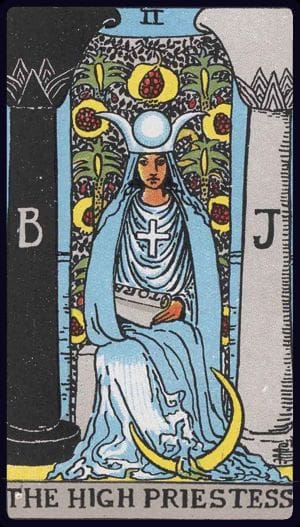
The High Priestess often reveals how uncomfortable we are with not knowing. She can point to intuition, but she can also point to impatience disguised as clarity.
A useful sentence might be:
Something in me already knows…
Something in me is not ready to say…
The silence around this question feels like…
The card does not ask you to abandon reason. It asks you to stop bullying the answer.
The High Priestess as the unconscious
In Jungian language, The High Priestess can be read as a guardian of the unconscious.
Not the unconscious as a storage room of random forgotten things, but as a symbolic and emotional field that speaks through dreams, images, slips, fantasies, bodily reactions, and repeated patterns. She sits where rational control begins to thin.
That is why she is often associated with veils, thresholds, moonlight, water, and books that are not fully legible. The point is not secrecy for its own sake. The point is that some knowledge changes when it is dragged too quickly into daylight.
Anyone who has tried to explain a dream too soon knows this. The dream becomes stupid. The image collapses. The feeling escapes. You are left with a plot summary and the sense that something important has been lost.
The High Priestess asks you to stay with the image a little longer.
Curious about the card? Read it two ways
On Tarot Told Me Instagram, you can start even if you are skeptical. We read cards in Skeptical Mode as prompts for reflection and in Mystical Mode as symbols with atmosphere, archetypes, and intuition.
The High Priestess and intuition
The word intuition is often overused until it means almost nothing: a vibe, a preference, a guess, a fear, a convenient excuse.
The High Priestess asks for more discipline than that.
Her intuition is not random impulse. It is pattern recognition before full explanation. It is the part of the psyche that notices tone, timing, repetition, tension, atmosphere, and absence. It may speak softly because it has not yet become an argument.
In a reflective tarot reading, The High Priestess might ask:
What am I noticing but dismissing?
What feels off before I can explain why?
What answer gets quieter when I try to prove it?
The danger is confusing intuition with anxiety. Anxiety is often urgent, repetitive, and hungry for reassurance. The High Priestess is usually quieter. She does not need fifteen more cards. She does not shout. She waits to be heard.
The High Priestess as the inner witness
The High Priestess is not only hidden knowledge. She is also the part of the psyche that can observe without immediately acting.
This is rare.
Most of us are trained to respond quickly: explain, decide, perform, fix, send, answer, optimize. The High Priestess introduces a more difficult skill: staying with what is present before turning it into content, confession, strategy, or advice.
In Jungian terms, this can matter because unconscious material does not always become conscious through force. Sometimes it needs a witness. A dream image, a recurring mood, a strange resistance, a bodily no, a phrase that keeps returning — these may not be ready for interpretation, but they can be noticed.
The High Priestess says: not everything you notice must be used immediately.
Some inner material needs to be protected from premature cleverness.
The shadow side of The High Priestess
The shadow of The High Priestess is not loud, which makes it harder to catch.
It can look like withdrawal, secrecy, emotional withholding, spiritual superiority, refusal to communicate, or hiding behind mystery when a plain answer is needed. She may also appear when someone mistakes silence for depth, or ambiguity for wisdom.
There is a difference between “I need time to understand what I feel” and “I will never tell you what is happening, but I expect you to sense it.”
There is a difference between intuition and avoidance.
A shadow reading of The High Priestess asks where silence has stopped being protective and started becoming a wall.
The question is not always “What do I know?” Sometimes it is:
What am I refusing to say because silence gives me power?
That is a sharper card than the usual soft-focus version of intuition. The High Priestess can be serene, but she is not harmless.
The High Priestess and the persona
The High Priestess has an uneasy relationship with persona.
Persona wants a readable face. The High Priestess keeps something back.
This can be liberating for people who are exhausted by constant self-explanation. You do not owe everyone access to your inner life. You do not need to narrate every feeling while it is still forming. Privacy can be psychologically necessary.
But privacy can also become performance.
The mysterious one.
The intuitive one.
The person who “just knows.”
The person who never has to explain.
When The High Priestess becomes persona, mystery hardens into identity. The person no longer listens inwardly; they perform inwardness.
A grounded question is:
Where am I protecting something real, and where am I hiding behind being unreadable?
Want to try it with guidance?
Tarot Told Me on YouTube has guided tarot practices, meditations, and a live stream where you can do a three-card spread in real time. Use it when you want the card to become a calm reflective practice, not another thing to decode alone.
The High Priestess and active imagination
The High Priestess is one of the best cards for active imagination because she does not answer directly.
Instead of asking what she means, imagine sitting across from her.
Do not make her explain herself too quickly. Ask one question and listen for the first response that arrives, even if it is strange, brief, or symbolic.
You might ask:
What are you guarding?
What is behind the veil?
What do I keep trying to know too soon?
What would happen if I waited?
The answer may come as a phrase, an image, a memory, or a feeling. It may not come at all.
That, too, can be information.
Active imagination with The High Priestess is not about inventing a dramatic message. It is about allowing a symbolic figure to reveal how you relate to mystery, patience, and inner knowledge.
The High Priestess and individuation
In the language of individuation, The High Priestess represents a necessary pause in the development of the self.
The Fool begins.
The Magician acts.
The High Priestess listens.
Without her, the journey becomes all will and no depth. The self learns to make, speak, and perform before it learns to receive, dream, and notice. That can produce competence, but not integration.
The High Priestess reminds the psyche that becoming whole requires a relationship with what is not yet conscious.
She does not rush the unconscious into a productivity system. She does not turn every dream into a lesson. She allows symbolic material to exist before it is translated.
This is part of maturity: knowing when to act and when to wait.
The High Priestess is the archetype of the second kind of knowing.
How to interpret The High Priestess as an archetype
A useful High Priestess reading begins with three questions: what is hidden, what is sensed, and what is being protected.
The hidden part may be a feeling, motive, memory, wish, fear, or truth that has not reached language.
The sensed part may be something you notice but cannot yet prove.
The protected part may be an inner boundary: something too tender, too early, or too private to expose.
For example:
Question: What am I not ready to say?
Card: The High Priestess
First reaction: She looks calm, but unreachable.
Reflection: I may be treating silence as wisdom because I am afraid that speaking will make the feeling less controllable.
Next step: Write the truth privately before deciding whether it needs to be shared.
The card does not demand confession.
It asks for honesty with yourself first.
Tarot Told Me note
The Tarot Told Me app is built for people who want tarot to feel like a reflection space, not a prediction machine. You can ask a question, pull a card, and save what tarot told you as a note to return to later.
Reflective prompts for The High Priestess
The best prompts for The High Priestess leave room for silence.
Where do I need privacy before clarity?
What would listening look like today?
Choose one question and give it time.
The High Priestess does not reward frantic interpretation.
Keep The High Priestess grounded
The High Priestess can become vague if every feeling is treated as sacred knowledge.
A grounded reading keeps intuition in conversation with reality. You can honor a sense that something feels wrong and still check facts. You can respect a private feeling and still communicate clearly when needed. You can wait for clarity without using waiting as a way to avoid responsibility.
The High Priestess is not an excuse to disappear.
She is an invitation to listen before speaking.
The question to carry back into the day is simple:
What needs more silence, and what needs a sentence?
When tarot is not therapy
Tarot can support journaling, self-reflection, symbolic thinking, and emotional awareness. It is not therapy, diagnosis, medical advice, legal advice, financial advice, or crisis support.
Jungian language can make a reading feel deep, but depth is not the same as care. If a reading increases panic, obsession, fear, or the urge to keep checking, stop. Reach for something steadier: a trusted person, rest, grounding, or a qualified professional.
Tarot can be part of a reflective practice.
It should not become the whole support system.
Suggested reading
— The Fool Tarot Card as a Jungian Archetype
— The Magician Tarot Card as a Jungian Archetype
— Tarot and Jung: Archetypes, Symbols, and Self-Reflection
FAQ
What is The High Priestess tarot archetype?
The High Priestess tarot archetype represents intuition, silence, hidden knowledge, receptivity, mystery, and the threshold between conscious thought and unconscious material.
How should beginners interpret The High Priestess?
Beginners can interpret The High Priestess by asking, “What do I already sense but have not admitted yet?” Look at your first reaction to the card, especially whether her silence feels calming, frustrating, mysterious, or intimidating.
What does The High Priestess mean in Jungian tarot?
In Jungian tarot, The High Priestess can be read as a guardian of the unconscious, a symbolic figure of inner knowledge, dream material, receptivity, and the wisdom that appears before language.
Is The High Priestess only about intuition?
No. The High Priestess can point to intuition, but she can also suggest privacy, secrecy, avoidance, hidden information, silence, waiting, or the need to let something remain unformed for a while.
What is the shadow side of The High Priestess?
The shadow side of The High Priestess can include emotional withholding, secrecy, spiritual superiority, avoidance, or using silence as control when honest communication is needed.
How is The High Priestess connected to individuation?
The High Priestess represents the psyche’s relationship with unconscious material. In individuation, she can show the need to listen, dream, receive, and notice before trying to act or explain.