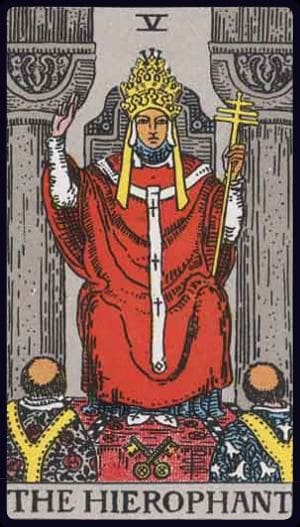
The Hierophant tarot archetype begins where private experience meets tradition.
After The Emperor, with his law, structure, throne, and boundary, The Hierophant brings us into a different kind of authority. Less fortress, more temple. Less command, more doctrine. He does not simply rule. He interprets. He teaches. He gives a system to what might otherwise remain private, chaotic, or unnamed.
In many decks, The Hierophant sits between pillars, with figures below him, often students, priests, or initiates. The image has ceremony in it. A hand raised in blessing. Keys. Robes. A position of sanctioned knowledge. Someone has decided what counts as sacred, correct, inherited, or true.
Psychologically, this makes The Hierophant one of the most complicated cards in the deck. He can represent wisdom, initiation, community, and meaningful tradition. He can also represent conformity, dogma, approval-seeking, and the part of the psyche that mistakes obedience for belonging.
Definition: The Hierophant tarot archetype represents tradition, teaching, initiation, belief systems, institutions, moral order, spiritual authority, and the need to place personal experience inside a larger structure of meaning. In a Jungian reading, he can be understood as the figure who mediates between individual experience and collective symbols.
The Hierophant after The Emperor
The Emperor builds the structure.
The Hierophant explains what the structure means.
This distinction matters. The Emperor asks for order. The Hierophant asks for legitimacy. He wants to know which rules are sacred, which customs are inherited, which gestures must be repeated, which language gives the group its sense of continuity.
The Emperor says: this is the law.
The Hierophant says: this is why the law matters.
At his best, he gives people a way to enter wisdom that is older than them. He teaches ritual, ethics, language, memory, and symbolic orientation. He reminds the individual ego that it did not invent the world.
At his worst, he turns living truth into dead instruction.
This is why a Hierophant reading is rarely neutral. People often react to him strongly. Some feel held by him. Others feel watched.
The voice may be a teacher, parent, institution, religion, culture, therapist, boss, book, community, algorithm, spiritual tradition, or inner rule that sounds so familiar you no longer hear it as someone else’s.
Then notice your reaction to the card. Does The Hierophant feel wise, oppressive, comforting, boring, holy, fake, necessary, old-fashioned? Do you want his approval? Do you want to rebel before he even speaks?
That first reaction is part of the reading.
A useful sentence might be:
The tradition I am inside is… The rule I have inherited is… The authority I need to question is…
The Hierophant does not ask you to reject tradition automatically. He asks whether you have a conscious relationship with it.
The Hierophant as teacher
The Hierophant can be a genuine teacher.
Not every structure is oppression. Not every tradition is empty. Not every inherited practice is a cage. Some things survive because they carry knowledge a single person cannot create alone.
A language. A ritual. A craft. A lineage of practice. A moral vocabulary. A way to sit with grief, birth, marriage, death, failure, devotion, uncertainty.
The individual psyche needs more than personal preference. It needs forms. It needs images and ceremonies large enough to hold experience when ordinary speech is too small.
The Hierophant offers that.
He can appear when you need to study, submit to a practice, learn the basics, respect the lineage, or stop pretending that sincerity alone is the same as understanding.
There is humility in this card.
The kind that says: I do not have to invent every path from zero.
The Hierophant as institution
The difficulty begins when teaching becomes control.
The Hierophant is never only a wise elder. He is also an institution. A system that decides who is inside and who is outside, who is pure and who is suspect, who speaks and who listens, who may interpret the symbol and who may only receive it.
That makes him psychologically sharp.
He can represent the part of the psyche that asks for permission before trusting its own experience. The inner official. The imagined committee. The ancestral courtroom. The voice that says: people like us do not do this.
Sometimes that voice protects. Often it polices.
A reflective Hierophant reading asks:
Where am I confusing approval with truth?
That question can be uncomfortable because approval is not always shallow. Sometimes approval means safety, family, employment, community, belonging. The psyche may cling to the institution because exile feels too expensive.
On Tarot Told Me Instagram, you can start even if you are skeptical. We read cards in Skeptical Mode as prompts for reflection and in Mystical Mode as symbols with atmosphere, archetypes, and intuition.
The Hierophant and collective symbols
Jungian psychology is especially useful for reading The Hierophant because the card lives between the personal and the collective.
A private feeling becomes easier to hold when it enters a shared symbolic language. Grief becomes a mourning ritual. Commitment becomes a vow. Learning becomes initiation. Confusion becomes a question asked inside a tradition that has held similar questions before.
The Hierophant is the keeper of these shared forms.
This can be beautiful. It can keep a person from feeling alone inside an experience that many humans have lived before.
But collective symbols can also become too heavy. A person may inherit a symbol and mistake it for a command. They may receive a moral system and confuse it with the voice of the self. They may perform belonging while slowly disappearing from their own life.
The Hierophant asks where the shared language supports the soul, and where it begins to replace it.
The Hierophant and belief
The Hierophant is a belief card, but not only in the religious sense.
Everyone has beliefs that organize reality.
What counts as success. What makes someone good. What must be earned. What cannot be forgiven. What kind of life is respectable. What kind of desire is allowed. What kind of knowledge is taken seriously.
Most of these beliefs do not announce themselves as beliefs. They feel like common sense.
The Hierophant turns common sense into an object of reflection.
He asks:
What have I mistaken for truth because everyone around me repeated it?
This is not a teenage rebellion card, though it can include rebellion. A mature Hierophant reading does not replace one dogma with another. It asks which beliefs still carry life and which have become inherited furniture: large, expensive, difficult to move, and no longer useful.
The shadow of The Hierophant is spiritual, moral, or intellectual authority without living contact.
Dogma. Conformity. Shame. Gatekeeping. Performative goodness. Fear of being wrong. Using tradition to avoid direct experience. Using language of meaning to control what may be felt.
This shadow often sounds calm. That is what makes it powerful. It may not shout. It may simply say: this is how things are done.
A shadow Hierophant can live inside religion, academia, therapy language, wellness culture, politics, family systems, corporate values, even tarot itself. Anywhere a living symbol becomes a rule that cannot be questioned, The Hierophant’s shadow is near.
The reflective question is:
Where have I outsourced my conscience to a system?
That is not the same as rejecting every system.
It means responsibility returns to the person using it.
The Hierophant and the persona
The Hierophant is deeply connected to persona because respectability is a costume with social rewards.
The good student. The serious seeker. The moral person. The spiritual one. The expert who cites the right names. The person who belongs because they know the code.
There may be real devotion inside these roles. The problem begins when the role becomes safer than truth.
A Hierophant persona may know the vocabulary of wisdom without being wise. It may know how to sound ethical while avoiding the harder private work of becoming honest. It may perform humility in precisely the approved style.
The card then asks:
Who am I trying to look correct for?
This is a brutal question for anyone who has survived by being good.
The Hierophant is not asking you to become careless. He is asking whether goodness has become a performance for an invisible authority.
Want to try it with guidance?
Tarot Told Me on YouTube has guided tarot practices, meditations, and a live stream where you can do a three-card spread in real time. Use it when you want the card to become a calm reflective practice, not another thing to decode alone.
The Hierophant and active imagination
The Hierophant is useful in active imagination because he usually appears with an atmosphere of instruction.
Imagine sitting across from him. Do not make him a villain too quickly. Do not make him holy too quickly. Ask what he protects.
What are you teaching me? What rule do you guard? What tradition do you serve? What happens if I disobey? What wisdom is still alive here? What part of this system is dead?
The answer may come as a sentence, a memory, a family phrase, a school rule, a religious image, a professional standard, or an old fear of disappointing someone.
For example:
Question: Whose approval am I still trying to earn? Card: The Hierophant First reaction: He looks calm, but I feel judged. Reflection: I may be treating an inherited standard as if it were my own value. Next step: Write the rule in plain language and decide whether I still choose it.
The Hierophant often becomes less frightening when the rule is named.
The Hierophant and individuation
In the language of individuation, The Hierophant represents one of the central tensions of becoming a self: the relationship between inherited meaning and personal truth.
No one individuates in a vacuum. We begin inside language, family, class, religion, culture, education, gender expectations, work systems, and collective myths. Some of these give us real ground. Some teach us how to become legible by becoming smaller.
The Hierophant is the gatekeeper of that inheritance.
A person cannot simply throw it all away and call that freedom. Rebellion can be another form of possession if the old authority still determines every move.
The mature question is not “Do I obey or rebel?”
The mature question is:
What do I consciously choose from what I inherited?
That is where The Hierophant becomes part of individuation. He asks the psyche to sort the living tradition from the dead command.
How to interpret The Hierophant as an archetype
A useful Hierophant reading begins with three questions: what tradition is present, what authority is speaking, and what meaning is being protected.
The tradition may be spiritual, family-based, cultural, professional, creative, intellectual, or moral.
The authority may be external or internal. A boss, teacher, parent, church, school, method, book, community, or old version of yourself.
The meaning may still be alive. That matters. The Hierophant is not only the card of restriction. Sometimes he appears because you need discipline, study, ritual, mentorship, or a path that has been walked before.
For example:
Question: What tradition am I inside? Card: The Hierophant First reaction: I want to roll my eyes at him. Reflection: I may reject structure too quickly because I associate all teaching with control. Next step: Separate the useful practice from the authority figure who first delivered it badly.
The strongest Hierophant prompts are not mystical. They are moral and practical.
Whose voice am I treating as authority? What rule have I inherited? What tradition still nourishes me? What belief has become too small for my life? Where am I confusing approval with truth? Where am I performing goodness? What do I want to learn properly? What do I consciously choose from what I was taught?
Choose one question.
The Hierophant is already full of voices. The reading does not need more noise.
Keep The Hierophant grounded
The Hierophant can become too abstract if every rule becomes “conditioning” and every tradition becomes “dogma.”
That is not discernment. It is another kind of reflex.
A grounded Hierophant reading asks what the structure actually does. Does it help you live with more integrity? Does it protect something sacred? Does it shame you into compliance? Does it teach a skill? Does it keep you dependent? Does it connect you to a lineage worth respecting?
The question to carry back into the day is:
Which rule still serves life, and which rule only serves obedience?
That is where the card becomes useful.
Not as rebellion.
Not as submission.
As discernment.
When tarot is not therapy
Tarot can support journaling, self-reflection, symbolic thinking, and emotional awareness. It is not therapy, diagnosis, medical advice, legal advice, financial advice, or crisis support.
Jungian language can make a reading feel deep, but depth is not the same as care. If a reading increases panic, obsession, fear, or the urge to keep checking, stop. Reach for something steadier: a trusted person, rest, grounding, or a qualified professional.
The Hierophant tarot archetype represents tradition, teaching, belief systems, institutions, moral order, spiritual authority, initiation, and the relationship between personal experience and collective meaning.
How should beginners interpret The Hierophant?
Beginners can interpret The Hierophant by asking, “Whose voice am I treating as authority?” Notice whether the card feels wise, oppressive, comforting, boring, sacred, or judgmental. That reaction reveals your relationship with rules, tradition, and belonging.
What does The Hierophant mean in Jungian tarot?
In Jungian tarot, The Hierophant can be read as the keeper of collective symbols, the teacher, the institution, or the figure who mediates between inherited meaning and individual experience.
Is The Hierophant a negative card?
No. The Hierophant is not automatically negative. He can suggest wisdom, mentorship, study, ritual, and belonging. His shadow side can include dogma, conformity, shame, and approval-seeking.
What is the shadow side of The Hierophant?
The shadow side of The Hierophant includes rigid belief systems, gatekeeping, spiritual superiority, moral performance, fear of being wrong, and obedience to rules that no longer serve life.
How is The Hierophant connected to individuation?
The Hierophant is connected to individuation through the tension between inherited tradition and personal truth. He asks what you consciously choose from what you were taught, and what you need to release.