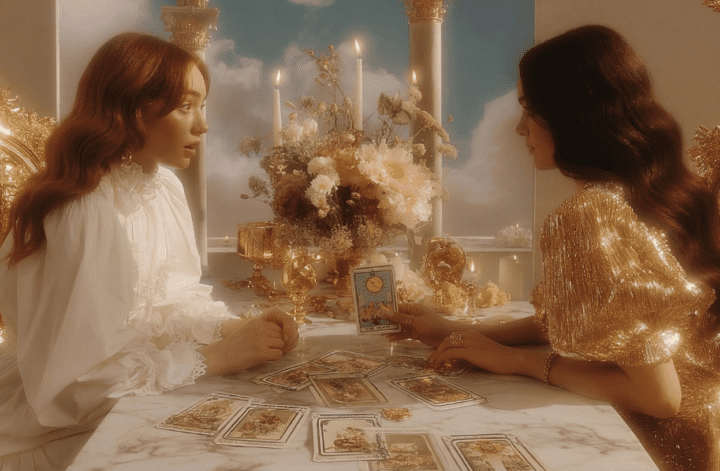
Tarot prompts for difficult days can help when everything feels too loud, heavy, or unclear to process at once.
The point is not to force a positive interpretation. It is to give your attention one card, one question, and one small place to begin.
On a difficult day, tarot works best when it stays gentle. No dramatic spreads. No urgent predictions. No “what does this mean for the rest of my life?” Just one grounded prompt that helps you notice what is happening inside you.
Definition: Tarot prompts for difficult days are reflective questions that use one tarot card to support emotional awareness, grounding, and small next steps during hard moments. They are not meant to predict outcomes or replace professional support.
When the day feels too much
Some days do not need a full reading.
They need a pause.
A difficult day can make every question feel bigger than it is. You may want certainty, reassurance, or a sign that things will be okay. That is understandable, but it can turn tarot into another anxious loop.
A calmer approach is to ask a smaller question:
What is here right now?
That question does not solve everything. It gives you a place to stand.
A beginner’s way to use this
Start with one card.
- Ask: “What do I need to notice right now?”
- Pull one card.
- Write your first reaction.
- Name one feeling.
- Choose one small next step.
Keep the whole practice under five minutes.
If you feel the urge to pull more cards, pause and write why. On a hard day, the need for another card often means you are looking for relief, not reflection.
Prompts for difficult days
Use one of these prompts with one card:
— What feeling needs to be named?
— What am I carrying that feels too heavy?
— What would help me feel 10% safer right now?
— What am I trying to solve too quickly?
— What do I need to put down for today?
— What is one thing I can do gently?
— What part of this is real, and what part is fear?
— What would grounding look like in the next ten minutes?
Do not answer all of them.
Choose the one that feels easiest to approach.
Example: when you feel overwhelmed
Question: What am I carrying that feels too heavy?
Card: Ten of Wands
First reaction: Exhaustion, pressure, too much.
Reflection: This might point to how much I am treating everything as mine to hold.
Next step: Pick one task that can wait.
The Ten of Wands does not need to become a dramatic warning.
On a difficult day, it can simply say: something is too heavy.
That is enough information to act more kindly.
Want a guided version? Try YouTube
Tarot Told Me on YouTube has guided tarot practices, meditations, and a live stream where you can do a three-card spread in real time. Use it when you want one question, one card, and a calm voice to help you stay with the reflection.
Example: when you feel anxious
Question: What part of this is real, and what part is fear?
Card: Nine of Swords
First reaction: Spiraling, worry, no sleep.
Reflection: This could suggest that my fear is repeating itself as if repetition makes it true.
Next step: Write one fact and one fear separately.
This is especially useful when a difficult day turns into mental noise.
A fact is something that happened.
A fear is something your mind is imagining.
Both can feel intense. They are not the same thing.
What to do with scary cards
If you pull The Tower, Death, The Devil, The Moon, or Nine of Swords on a hard day, slow down before interpreting.
A difficult card is not a sentence.
Try reading it through a grounded frame:
— The Tower can point to honesty, pressure, or something that needs repair.
— Death can point to an ending, release, or transition.
— The Devil can point to attachment, avoidance, or a pattern that feels hard to leave.
— The Moon can point to uncertainty, fear, or imagination filling the gaps.
The question matters more than the card name.
Ask: “What does this help me notice?” before asking “What does this mean?”
Curious about the card? Read it two ways
On Tarot Told Me Instagram, we explore cards in Skeptical Mode and Mystical Mode: as prompts for reflection and as symbols with atmosphere, archetypes, and intuition. You’ll also find lighter tarot stories there — celebrity card pairings, card aesthetics, and why men can be some of the biggest tarot fans.
A short grounding practice
When the reading feels too emotional, bring it back to the body.
Place the card in front of you. Name five things you can see, then write one sentence:
Right now, this card helps me notice…
That sentence can be very simple:
Right now, this card helps me notice that I am tired.
Right now, this card helps me notice that I need a pause.
Right now, this card helps me notice that I am scared, but I am here.
You do not need to turn the reading into a breakthrough.
A grounded note is enough.
When tarot is not enough
Tarot can support reflection, journaling, and emotional awareness.
It is not therapy, diagnosis, medical advice, legal advice, financial advice, or crisis support.
If a reading increases panic, obsession, fear, or the urge to keep checking, stop. Put the cards away and reach for something steadier: a person you trust, a grounding practice, rest, or qualified professional support.
A tarot practice should help you return to yourself.
It should not make the difficult day harder.
Suggested reading
— Tarot Reflection Prompts for Overthinking
— One Card, One Question, One Note: A Reflective Tarot Routine
— Evening Tarot Reflection Practice: How to Close the Day With One Card
— Morning Tarot Reflection Practice: A Simple Daily Card Ritual
FAQ
Can tarot help on difficult days?
Tarot can help on difficult days when it is used as a gentle reflection prompt. One card can help you name a feeling, separate fear from fact, and choose a small next step.
How should beginners use tarot on a hard day?
Beginners should keep the reading very small: one card, one question, and one sentence. Ask “What do I need to notice right now?”, write your first reaction, and stop before the reading turns into reassurance-seeking.
What is the best tarot prompt for a hard day?
A useful prompt is: “What do I need to notice right now?” It keeps the reading grounded and avoids forcing a prediction.
Should I pull more cards if I feel upset?
Usually no. If you feel upset, more cards can create more anxiety. Try staying with one card and writing your first reaction.
What if I pull a scary card?
Pause before interpreting it. A scary card can be read as a prompt for honesty, release, uncertainty, or a pattern that needs attention.
Is tarot a mental health tool?
Tarot can support journaling and self-reflection, but it is not therapy, diagnosis, or mental health treatment.
Stay with the smallest question
A difficult day does not need a dramatic reading.
It needs a softer question.
One card can be enough if it helps you name what is here, put down what is too heavy, or take one grounded step.
Start there.