
The Emperor tarot archetype begins where life asks for structure.
After The Empress, with her garden, body, pleasure, nourishment, and growth, The Emperor arrives with stone, law, posture, and rule. He does not ask what wants to bloom. He asks what can stand.
In many decks, he sits on a throne. The landscape behind him is often dry, mountainous, or severe. His body is armored or formal. He is not hidden like The High Priestess or lush like The Empress. He is visible, fixed, declared. He has edges.
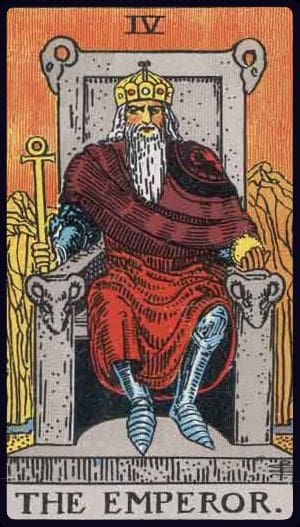
It is easy to reduce The Emperor to authority, patriarchy, fathers, institutions, control. Those meanings matter. But psychologically, The Emperor is larger than any one social role. He is the archetype of order: the part of the psyche that builds a container strong enough for life to continue.
Definition: The Emperor tarot archetype represents structure, authority, boundaries, law, discipline, protection, responsibility, and the ordering principle of the psyche. In a Jungian reading, he can be understood as the figure who gives form, limits, and stability to what might otherwise remain chaotic or uncontained.
The Emperor after The Empress
The Empress grows.
The Emperor defines.
This sequence matters because growth without structure can become diffusion. A garden needs soil, light, water, time, but also boundaries. Without a path, a fence, a rhythm, or a limit, abundance can become overgrowth.
The Emperor is the card that says: not everything can spread forever.
He is not the enemy of life. At his best, he protects it. He makes a space where something can be held, named, defended, repeated, and passed on.
In a reflective reading, The Emperor often appears when the question is no longer “What needs nourishment?” but “What needs a container?”
That container might be a schedule, a boundary, a decision, a rule, a contract, a budget, a role, a standard, or the simple courage to say: this is what we are doing, and this is what we are not doing.
A beginner’s way to read The Emperor
A beginner can start with the physical feeling of the card.
Does The Emperor make you feel safe, tense, irritated, judged, relieved, bored, protected, controlled? Your reaction is part of the reading.
Ask:
Where do I need more structure?
Then ask the less comfortable second question:
Where has structure become control?
The Emperor is rarely useful when read only in one direction. Too little Emperor and life becomes scattered. Too much Emperor and life becomes rigid.
A grounded sentence might be:
The structure I need is…
The limit I am avoiding is…
The rule that has become too tight is…
The Emperor does not ask you to become hard. He asks whether something in your life needs firmer edges.
The Emperor as the father principle
In Jungian and archetypal language, The Emperor can be read through the father principle: authority, law, protection, separation, order, inheritance, and the demand to enter the world as someone accountable.
This is not the same as saying The Emperor is only about literal fathers.
A literal father may carry this archetype well, badly, inconsistently, or not at all. An institution can carry it. A boss can carry it. A government can carry it. A company policy can carry it. A person’s own inner voice can carry it, sometimes with care, sometimes with cruelty.
The father principle says: the world has consequences.
That can sound harsh. It can also be merciful.
A psyche without any inner Emperor may struggle to choose, protect time, set standards, keep promises, leave chaotic situations, or turn desire into something durable.
A psyche ruled entirely by The Emperor may confuse control with safety and obedience with maturity.
The card asks which version is active.
The Emperor and boundaries
The Emperor is one of the clearest boundary cards in the deck.
But his boundary is not only interpersonal. It is architectural.
He asks what the structure of your life allows and what it forbids. He asks where your calendar lies. Where your money leaks. Where your yes means nothing because it has no limit. Where your kindness collapses because it has no form.
The Emperor is not impressed by vague intention.
He wants the rule.
Not a rule that punishes life, but a rule that protects it.
If The Empress says, “This needs nourishment,” The Emperor says, “Then where will it live?”
A creative practice needs hours. A relationship needs agreements. A business needs numbers. A body needs sleep. A boundary needs a sentence that can survive discomfort.
The Emperor brings love down into logistics.
That is not romantic.
It is often what makes care real.
Curious about the card? Read it two ways
On Tarot Told Me Instagram, you can start even if you are skeptical. We read cards in Skeptical Mode as prompts for reflection and in Mystical Mode as symbols with atmosphere, archetypes, and intuition.
The Emperor as law
The Emperor is the card of law in the broadest sense: the rules that hold a world together.
Every psyche has laws, even when they are unconscious.
Do not need too much.
Never look weak.
Be useful.
Stay impressive.
Do not make mistakes.
Keep control.
Do not trust softness.
Earn rest.
Some inner laws protect us. Others outlive the danger that created them.
A Jungian reading of The Emperor can ask: whose law am I living under?
This is where the card becomes psychologically sharp. The Emperor may show not only healthy discipline, but inherited command. Family rules. Cultural rules. Gender rules. Work rules. The old authority speaking through your own inner voice.
When The Emperor appears, listen for the tone of command.
Is it firm and protective?
Or is it contemptuous, frightened, punitive, brittle?
A real authority does not need to humiliate you to be obeyed.
The shadow side of The Emperor
The shadow of The Emperor is control pretending to be responsibility.
Rigidity.
Domination.
Coldness.
Fear of vulnerability.
Obedience to dead rules.
Protection that becomes possession.
Standards used as weapons.
Authority that cannot listen.
This is the version of The Emperor that makes life smaller in the name of keeping it safe.
He may appear when you are trying to control every outcome because uncertainty feels intolerable. He may appear when you call something “discipline” that is really fear. He may appear when you are enforcing rules no one consciously chose.
The hardest question The Emperor asks is:
What am I controlling because I do not know how to trust?
That question does not make structure bad.
It makes structure honest.
The Emperor and the persona
The Emperor has a strong relationship with persona because authority is often performed.
The competent one.
The serious one.
The provider.
The leader.
The person who never loses composure.
The one who always knows what to do.
There may be real strength inside that role. The problem begins when the person becomes trapped in it.
An Emperor persona can be admired from the outside and lonely from the inside. It can produce success, respect, stability, and a life where no one knows how tired the person is. It can also make asking for help feel like a loss of rank.
The Emperor then asks:
Who am I when I am not in charge?
That question can feel threatening if authority has become identity.
But without it, the throne becomes a prison.
Want to try it with guidance?
Tarot Told Me on YouTube has guided tarot practices, meditations, and a live stream where you can do a three-card spread in real time. Use it when you want the card to become a calm reflective practice, not another thing to decode alone.
The Emperor and active imagination
The Emperor is useful in active imagination because he usually has something to say.
Imagine sitting before him. Do not make him automatically wise or automatically oppressive. Let the figure speak in his own tone.
Ask:
What are you protecting?
What rule do you enforce?
What are you afraid would happen without you?
Where have you become too rigid?
What structure do I actually need?
The answer may surprise you.
A harsh Emperor may reveal fear underneath control. A distant Emperor may reveal exhaustion. A protective Emperor may offer a clean rule that simplifies everything.
For example:
Question: What structure do I need?
Card: The Emperor
First reaction: He looks severe, but calm.
Reflection: I may need a firm work boundary, not another attempt to “manage my energy” emotionally.
Next step: Set one non-negotiable end time this week.
The Emperor often speaks in specifics.
That is part of his medicine.
The Emperor and individuation
In the language of individuation, The Emperor can represent the psyche’s need to develop inner authority.
Not borrowed authority. Not obedience. Not rebellion against every rule because rules once hurt you.
Inner authority.
This means the capacity to choose a structure consciously and live inside it without becoming possessed by it. It means knowing when to say yes, when to refuse, when to protect, when to build, and when to dismantle the law you once needed.
Without The Emperor, individuation can remain dreamy. A person may understand their symbols, feelings, wounds, and longings, but still fail to organize a life that supports them.
With too much Emperor, individuation becomes performance. The person becomes effective, impressive, controlled, and increasingly cut off from the living parts of the self.
A mature Emperor does not crush The Empress’s garden.
He builds the wall that keeps it from being destroyed.
How to interpret The Emperor as an archetype
A useful Emperor reading begins with three questions: what needs structure, what needs protection, and what has become too rigid.
The structure may be practical: time, money, work, agreements, sleep, boundaries, planning.
The protection may be emotional: your attention, your privacy, your energy, your ability to keep a promise to yourself.
The rigidity may be the part of life where the rule has outlived its purpose.
For example:
Question: What needs a firmer boundary?
Card: The Emperor
First reaction: I feel judged by him.
Reflection: I may associate structure with criticism, so I avoid the exact boundary that would make me feel safer.
Next step: Write one clear rule without insulting myself into following it.
The Emperor does not ask for self-punishment.
He asks for architecture.
Tarot Told Me note
The Tarot Told Me app is built for people who want tarot to feel like a reflection space, not a prediction machine. You can ask a question, pull a card, and save what tarot told you as a note to return to later.
Reflective prompts for The Emperor
The best Emperor prompts are direct.
Where do I need more structure?
Where has structure become control?
What rule am I living under?
What boundary would protect what matters?
Where am I performing authority instead of feeling grounded?
What am I controlling because I do not know how to trust?
Choose one question.
The Emperor does not need a dramatic spread. He needs a clear answer and a structure that can hold.
Keep The Emperor grounded
The Emperor can easily become either a villain or a fantasy.
Some readers reject him because he looks like every authority that ever controlled them. Others overvalue him because he promises order, certainty, and command.
A grounded reading avoids both extremes.
The Emperor is not automatically oppression. He is not automatically wisdom. He is the principle of structure, and structure can protect or imprison depending on how it is used.
The question to carry back into the day is:
What limit would make more life possible?
That is The Emperor at his best.
Not power for its own sake.
A form strong enough to hold what matters.
When tarot is not therapy
Tarot can support journaling, self-reflection, symbolic thinking, and emotional awareness. It is not therapy, diagnosis, medical advice, legal advice, financial advice, or crisis support.
Jungian language can make a reading feel deep, but depth is not the same as care. If a reading increases panic, obsession, fear, or the urge to keep checking, stop. Reach for something steadier: a trusted person, rest, grounding, or a qualified professional.
Tarot can be part of a reflective practice.
It should not become the whole support system.
Suggested reading
— Tarot and Psychology: Why Cards Feel So Personal
— Tarot Reflection Prompts for Boundaries
— Tarot Reflection Prompts for Difficult Days
FAQ
What is The Emperor tarot archetype?
The Emperor tarot archetype represents structure, authority, law, discipline, responsibility, protection, boundaries, and the ordering principle of the psyche.
How should beginners interpret The Emperor?
Beginners can interpret The Emperor by asking, “Where do I need more structure?” Then notice whether the card feels safe, controlling, irritating, relieving, or severe. That reaction helps reveal your relationship with authority and boundaries.
What does The Emperor mean in Jungian tarot?
In Jungian tarot, The Emperor can be read as the father principle, inner authority, law, protection, structure, and the psyche’s need for a stable container.
Is The Emperor a negative card?
No. The Emperor is not automatically negative. He can suggest healthy discipline, protection, and responsibility. His shadow side can include control, rigidity, domination, or fear of vulnerability.
What is the shadow side of The Emperor?
The shadow side of The Emperor is control pretending to be responsibility. It can show up as harsh rules, emotional coldness, domination, perfectionism, or authority that cannot listen.
How is The Emperor connected to individuation?
The Emperor can represent the development of inner authority during individuation. He helps the psyche build structure, set limits, and take responsibility without becoming rigid or disconnected from life.