
The Fool reversed often appears when a beginning has become complicated.
Upright, The Fool carries openness, risk, curiosity, movement, and the strange freedom of not knowing what comes next. Reversed, that energy can turn inward, stall, or become reckless. You may want to begin but keep waiting for certainty. Or you may be moving too quickly because slowing down would force you to notice what you are actually afraid of.
The Fool reversed is less about a bad beginning than about your relationship to uncertainty.
Definition: The Fool reversed can point to fear of starting, reckless action, poor preparation, naïveté, hesitation, or a beginning that needs more grounding before you move.
The Fool reversed and the fear of beginning
Some beginnings look like opportunity from the outside and danger from the inside.
A new job. A first date after a long relationship. Moving somewhere unfamiliar. Publishing your work. Starting a business. Saying yes to something you cannot fully control.
The Fool reversed can appear when the threshold itself has become the problem.
You may keep preparing because preparation feels safer than exposure. You may wait for confidence even though confidence is unlikely to arrive before experience. You may call yourself cautious when what you really mean is frightened.
What Does It Mean If You Pulled The Fool Reversed?
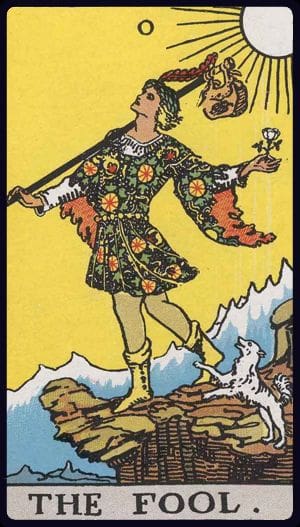
This card does not automatically tell you to jump.
It asks what is keeping your foot from leaving the ground.
Sometimes the answer is wisdom.
Sometimes it is fear wearing wisdom’s clothes.
A beginner’s way to read The Fool reversed
Start with one question:
Am I holding back, or am I rushing?
That distinction matters because The Fool reversed can point in either direction.
Maybe you have been postponing something because you are afraid of looking inexperienced. Maybe you have ignored obvious risks because the excitement of beginning feels better than planning.
Look at the situation itself before attaching a dramatic meaning to the card.
A useful sentence might be:
The beginning I am avoiding is…
The risk I am underestimating is…
The information I need before moving is…
The Fool reversed works best when it helps you separate fear from caution.
When The Fool reversed means hesitation
The most common version of The Fool reversed is stalled movement.
You want the new thing, but you keep finding one more reason to delay. Another course. Another conversation. Another week. Another version of the plan.
At some point, preparation stops preparing you.
It starts protecting you from being seen as a beginner.
That can be the uncomfortable message of The Fool reversed. You may know enough. You may already have the invitation, the idea, the application, the draft, the ticket.
The missing ingredient is not more information.
It is tolerance for uncertainty.
A reflective question for this version of the card is:
What would I do if I were allowed to start badly?
That question can be surprisingly freeing.
When The Fool reversed means recklessness
There is another side to the card.
Sometimes The Fool reversed appears because you are already halfway over the cliff.
The excitement of something new can make ordinary caution feel boring. You may be romanticizing a move, a relationship, a business decision, or a major change because imagining the future feels easier than examining the conditions.
This does not mean you should abandon the idea.
It means the idea deserves reality.
What have you not checked? What assumption are you treating as fact? What would make the risk cleaner?
The Fool reversed can be the card that asks you to look down before you leap.
Not because the cliff is always dangerous.
Because pretending it is not there is not courage.
Curious about the card? Read it two ways
On Tarot Told Me Instagram, you can start even if you are skeptical. We read cards in Skeptical Mode as prompts for reflection and in Mystical Mode as symbols with atmosphere, archetypes, and intuition.
The Fool reversed and naïveté
Naïveté is not the same as stupidity.
Often it is simply a lack of experience.
The Fool reversed can appear when you are entering a situation without enough context to understand what you do not know yet. That is normal at the beginning. The problem comes when not knowing is treated as proof that preparation is unnecessary.
There is a useful kind of innocence that keeps people curious.
There is also the kind that assumes consequences will arrange themselves.
The card may ask:
What am I expecting to work out on its own?
Maybe it will.
But this is the moment to know which parts of the plan depend on luck.
The Fool reversed in love
In love, The Fool reversed can point to fear of opening up, hesitation around a new relationship, impulsive attraction, or entering something without enough clarity.
If you are single, the card may reflect a tension between wanting connection and wanting to avoid vulnerability. You may like the idea of beginning again while distrusting everything a real beginning requires.
If you are already in a relationship, The Fool reversed can appear around an impulsive decision, a new stage you are not ready for, or a pattern of avoiding serious conversations by keeping everything light.
The grounded question is:
What would make this beginning feel both alive and safe enough?
The answer might be time, honesty, boundaries, or simply admitting that you do not know yet.
That is allowed.
The Fool reversed in work and career
In a career reading, The Fool reversed often appears around transition.
You may want to change industries, apply for something above your current level, leave a role, start freelancing, build a project, or return to work after a break.
The card can show fear of becoming inexperienced again.
This matters because career identity can make beginners feel particularly threatening. You may be highly competent in one context and suddenly awkward in another. The Fool reversed exposes the part of you that would rather stay excellent at something you no longer want than become average at something you do.
It can also warn against the opposite mistake: quitting before understanding the practical consequences.
A good question here is:
What part of this decision needs courage, and what part needs a spreadsheet?
The Fool reversed likes both.
The Fool reversed and self-trust
People sometimes read The Fool reversed as a lack of confidence.
That is only partly true.
More often, it shows a problem with self-trust.
Confidence says: I know I can do this.
Self-trust says: I can respond even if I do not know exactly what happens.
Beginnings rarely offer the first kind of certainty.
They require the second.
The Fool reversed may appear when you are demanding proof from yourself that no beginning can provide.
You want to know the move will work before you move. You want to know the relationship will last before becoming vulnerable. You want to know the project will succeed before risking embarrassment.
The card asks whether certainty has become an impossible entry requirement.
When caution becomes avoidance
Caution deserves respect.
It is easy to turn tarot into a machine that romanticizes risk: follow your heart, trust the universe, leap and the net will appear.
The Fool reversed can be a useful correction to that language.
Sometimes you should not leap.
But there is also a point where caution stops producing useful information.
You already know the risks. You have considered the alternatives. You are not learning anything new by postponing. You are simply experiencing the temporary relief of not choosing.
That is avoidance.
The Fool reversed asks you to recognize the difference.
When freedom becomes escape
The Fool is often associated with freedom.
Reversed, the card can ask whether what feels like freedom is actually escape.
Leaving every job when responsibility begins. Ending relationships when intimacy gets uncomfortable. Starting new projects before the old one becomes difficult. Moving constantly because staying would mean confronting something.
Novelty can feel incredibly alive.
It can also protect us from depth.
The reflective question becomes:
Am I moving toward something, or only away?
Sometimes both are true.
That is still worth knowing.
Want to try it with guidance?
Tarot Told Me on YouTube has guided tarot practices, meditations, and a live stream where you can do a three-card spread in real time. Use it when you want the card to become a calm reflective practice, not another thing to decode alone.
How to reflect on The Fool reversed
The Fool reversed works well as a card for examining a threshold.
Write down the thing you are considering beginning.
Then write the sentence you usually tell yourself about why you have not started.
Read it once without arguing with it.
Now ask what percentage of that sentence is practical information and what percentage is fear.
You do not need a precise number. The exercise is simply a way to stop treating every anxious thought as evidence.
If the issue is recklessness rather than hesitation, reverse the exercise. Write what you are excited about, then name the practical condition you would rather not think about.
The Fool reversed becomes much clearer when excitement and fear are placed next to facts.
The Tarot Told Me app is built for people who want tarot to feel like a reflection space, not a prediction machine. You can ask a question, pull a card, and save what tarot told you as a note to return to later.
Reflective prompts for The Fool reversed
Where am I afraid to be a beginner?
What risk am I underestimating?
What am I waiting to know before I allow myself to start?
Where has caution become avoidance?
Where has freedom become escape?
What would a smaller experiment look like?
What consequence am I pretending does not matter?
What would it mean to trust myself without pretending I know the outcome?
Choose one.
The Fool reversed is already standing at a threshold. It rarely needs ten more cards around it.
Keep The Fool reversed grounded
The Fool reversed is easy to dramatize.
It does not mean disaster is waiting if you proceed. It does not mean the universe is warning you away from every new thing. It also does not mean you should ignore practical concerns and prove your courage by taking the biggest possible risk.
The grounded version is simpler.
Check the facts. Notice the fear. Respect the risk. Decide whether another week of waiting will genuinely teach you anything.
Then choose the size of the next step.
A beginning does not have to be a cliff.
Sometimes it is an email.
When tarot is not therapy
Tarot can support journaling, self-reflection, symbolic thinking, and emotional awareness. It is not therapy, diagnosis, medical advice, legal advice, financial advice, or crisis support.
If a reading increases panic, obsession, fear, or the urge to keep checking the same question, stop. Reach for steadier support: a trusted person, rest, grounding, or a qualified professional.
Tarot can be part of a reflective practice.
It should not become the whole support system.
Suggested reading
— Tarot Reflection Prompts for Decision-Making
— Tarot and Jung: Archetypes, Symbols, and Self-Reflection
— Tarot and Psychology: Why Cards Feel So Personal
FAQ
What does The Fool reversed mean?
The Fool reversed can mean fear of beginning, hesitation, reckless action, poor preparation, naïveté, or uncertainty about taking a new step.
How should beginners interpret The Fool reversed?
Start by asking whether you are holding back or rushing forward. The Fool reversed often highlights either excessive caution or insufficient grounding around a beginning.
Is The Fool reversed a bad card?
No. The Fool reversed is not automatically negative. It can simply suggest that a new beginning needs more reflection, preparation, or courage before you move.
What does The Fool reversed mean in love?
In love, The Fool reversed can point to fear of vulnerability, hesitation about a new relationship, impulsive attraction, or entering a connection without enough clarity.
What does The Fool reversed mean for work?
In work, The Fool reversed can suggest fear of a career change, reluctance to become a beginner again, or an impulsive professional decision that needs more practical planning.
Does The Fool reversed mean I should not take the risk?
Not necessarily. The Fool reversed asks you to examine the risk rather than automatically avoid or take it. Check whether your hesitation is useful caution or fear, and whether your excitement is grounded in reality.