The Lovers tarot archetype begins with attraction, but it rarely ends there.
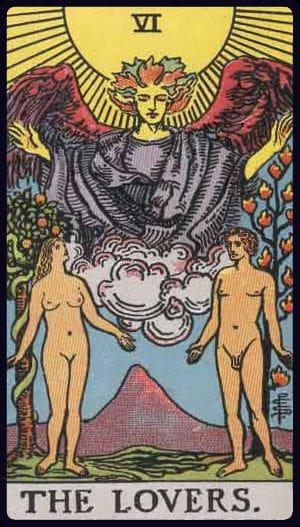
The card is easy to flatten into romance. Two figures. A charged encounter. The promise of union. In some decks, an angel hovers above them; in others, a choice is more obvious, almost theatrical. But the psychological force of The Lovers is larger than couplehood. It is about the pull between opposites, the discomfort of choosing, and the way another person can make parts of us visible that were difficult to see alone.
In a Jungian reading, The Lovers can be understood as an image of relationship in the broadest sense: relationship to another person, to desire, to conflict, to values, and to the parts of the psyche that do not naturally agree with one another.
Definition: The Lovers tarot archetype represents attraction, choice, relationship, inner polarity, values, projection, and the tension between two forces that ask to be consciously related rather than simply obeyed.
The Lovers after The Hierophant
The Hierophant gives you a system.
The Lovers asks whether you actually choose it.
That is one reason the sequence feels psychologically precise. The Hierophant introduces tradition, inherited beliefs, the moral language of the group, the rules that tell us what love, success, loyalty, goodness, and belonging are supposed to look like.
Then The Lovers arrives.
Suddenly there is another person, another desire, another possibility, another self.
What you inherited meets what you want.
Sometimes they agree. Often they do not.
The Lovers is where life begins to become personal.
A rule may have sounded perfectly reasonable until you fall in love with someone your family would not choose. A career path may have felt stable until another desire starts asking for space. A value may seem clear until two values you care about demand opposite decisions.
The Lovers turns abstract morality into lived conflict.
A beginner’s way to read The Lovers
Start with a question that has nothing to do with predicting romance:
What am I being asked to choose consciously?
Then notice what the card does to you.
Do you immediately think of a partner? Do you feel comfort, envy, longing, pressure? Does the word “choice” make you tense? Are you more interested in union, or in the possibility of being chosen?
Your first reaction can reveal which part of The Lovers is alive in the reading.
A useful sentence might be:
What I want is…
What I value is…
Where those two conflict is…
The Lovers becomes much more interesting when desire and values are allowed to be different things.
The Lovers Tarot Card as a Jungian Archetype
The Lovers as inner opposition
Jungian psychology is full of tensions that are not meant to be solved too quickly.
Conscious and unconscious. Persona and shadow. Reason and feeling. Independence and attachment. The life we planned and the life that keeps interrupting it.
The Lovers can represent that kind of opposition.
The card does not always ask which side is correct. Sometimes the important thing is discovering that both sides exist.
You want freedom and reassurance. You want intimacy and privacy. You want to be ambitious and less consumed by work. You want to leave and to be asked to stay.
Modern self-help language often treats contradiction like a bug.
The psyche is less tidy.
A Jungian reading lets The Lovers hold the contradiction long enough for a more honest choice to emerge.
That is why the card can feel uncomfortable even when no romance is involved.
The Lovers and projection
Relationships have a special psychological intensity because other people become screens.
We see them, but we also see what we carry.
Longing, fear, ideals, old wounds, fantasy, expectations, possibilities we have not lived ourselves. Jungian psychology gives projection a central place in understanding relationship: qualities or conflicts that are difficult to recognize internally can be experienced as if they belong entirely to someone else.
The Lovers is therefore a useful card for asking what part of the attraction belongs to the person in front of you, and what part belongs to the image you have placed around them.
This does not make love unreal.
It makes it psychologically complicated.
Sallie Nichols’ Jung and Tarot treats the Major Arcana as an archetypal journey related to individuation rather than as a simple fortune-telling sequence. Her approach places cards such as The Lovers inside the larger question of how symbolic images reveal psychic patterns and projections.
A useful Lovers question is:
What am I seeing in this person that I may also need to recognize in myself?
That question can soften both idealization and blame.
On Tarot Told Me Instagram, you can start even if you are skeptical. We read cards in Skeptical Mode as prompts for reflection and in Mystical Mode as symbols with atmosphere, archetypes, and intuition.
The Lovers and desire
Desire is inconvenient because it reveals hierarchy.
We say many things matter to us. Desire shows which ones have heat.
The Lovers can appear when something has moved from abstract preference into embodied wanting. You do not merely think a life might suit you. You want it. You do not merely admire a person. Their presence changes the emotional weather.
That does not mean desire should rule the decision.
But pretending it is irrelevant usually makes it more powerful.
The Lovers asks you to give desire a seat at the table without automatically giving it the chair.
This can be difficult for people who have learned to be sensible, useful, loyal, agreeable, or correct. Desire can feel selfish because it introduces a private truth into a system built around obligation.
The card asks:
What do I want when no one is grading the answer?
That question may produce relief.
It may also produce trouble.
Both are information.
The Lovers and values
The Lovers is often called a card of choice, but “choice” can sound deceptively simple.
Many meaningful choices are difficult precisely because both options matter.
Stay and protect stability, or leave and protect aliveness.
Tell the truth and risk the relationship, or stay quiet and protect the peace.
Choose the opportunity that looks better, or the one that feels more aligned with the life you actually want.
A Lovers reading becomes shallow if it only asks, “Which one?”
The stronger question is:
Which choice can I live inside without abandoning myself?
That does not promise a painless decision.
It shifts the standard.
The goal is not to eliminate loss. Every real choice closes something. The goal is to understand what value you are serving when you choose.
The shadow side of The Lovers
The shadow of The Lovers appears when relationship becomes a way to avoid relationship with the self.
Idealization.
Dependency.
Chronic indecision.
Self-betrayal in exchange for closeness.
Treating chemistry as evidence of compatibility.
Treating conflict as evidence that love has failed.
The card’s romantic imagery can make these patterns look beautiful.
That is why The Lovers needs grounding.
A person can feel extraordinary attraction toward someone who activates an old wound. A decision can feel “meant to be” because it is familiar, not because it is good. An intense bond can make compromise feel sacred even when the compromise is always one-sided.
A shadow Lovers question is:
What am I giving up in order to stay chosen?
Sometimes the answer is small.
Sometimes it changes the entire reading.
The Lovers and persona
The Lovers can destabilize persona because intimacy makes polished identities difficult to maintain.
You may be the independent one until you fall in love and discover how much reassurance you need. The calm one until jealousy appears. The rational one until desire rearranges your priorities.
Relationship introduces witnesses.
Someone sees the part of you that does not fit the public version.
This can be humiliating and liberating at once.
The Lovers asks whether connection allows more of you to exist, or whether you are editing yourself harder in order to remain lovable.
That question matters beyond romance. Friendship, collaboration, family, and creative partnership can all activate the same tension.
Who do I become in order to belong here?
The answer tells you a great deal about the relationship.
The Lovers and individuation
Jungian individuation is concerned with becoming a more integrated person rather than identifying with one acceptable fragment of the self. Nichols explicitly relates her Jungian reading of tarot to individuation, treating the Major Arcana as images within a psychological journey rather than fixed personality labels.
The Lovers matters in that journey because integration is relational.
Opposites do not disappear because we prefer one of them.
The ambitious self does not destroy the tired self. The independent self does not cancel the attached self. The person who wants safety and the person who wants change must somehow inhabit the same life.
The Lovers offers an image for this encounter.
Not perfect harmony.
Conscious relationship.
That distinction is important. Integration does not mean all parts agree. It means the conflict is no longer happening entirely in the dark.
Want to try it with guidance?
Tarot Told Me on YouTube has guided tarot practices, meditations, and a live stream where you can do a three-card spread in real time. Use it when you want the card to become a calm reflective practice, not another thing to decode alone.
How to interpret The Lovers as an archetype
A useful Lovers reading begins with three things: attraction, conflict, and choice.
Attraction shows where energy is moving.
Conflict shows what does not fit neatly together.
Choice shows what you are willing to stand behind.
For example:
Question: Why is this decision so difficult?
Card: The Lovers
First reaction: I want someone else to tell me what to choose.
Reflection: Both options may represent values I genuinely care about, which is why neither feels clean.
Next step: Name what I would protect with each choice, then decide which loss I am more willing to carry.
The Lovers does not remove ambiguity.
It makes the ambiguity personal.
The Tarot Told Me app is built for people who want tarot to feel like a reflection space, not a prediction machine. You can ask a question, pull a card, and save what tarot told you as a note to return to later.
Reflective prompts for The Lovers
What am I being asked to choose consciously?
Where do desire and values disagree?
What am I projecting onto another person?
Who do I become in order to stay connected?
What part of myself is this relationship making visible?
Where am I confusing attraction with compatibility?
What choice would require the least self-betrayal?
What would connection look like if I did not have to disappear inside it?
Choose one question.
The Lovers already contains two voices. Give them room to speak.
Keep The Lovers grounded
The Lovers can become sentimental very quickly.
A grounded reading remembers that connection does not automatically mean compatibility, desire does not automatically mean destiny, and conflict does not automatically mean failure.
Sometimes the card appears because a relationship matters.
Sometimes because a choice matters.
Sometimes because two parts of you have reached the point where pretending only one exists is no longer working.
The useful question is not always “Who is this person to me?”
Sometimes it is:
What does this relationship reveal about how I choose?
When tarot is not therapy
Tarot can support journaling, self-reflection, symbolic thinking, and emotional awareness. It is not therapy, diagnosis, medical advice, legal advice, financial advice, or crisis support.
Jungian language can make a reading feel psychologically rich, but tarot should not be used to diagnose yourself or another person. If a reading increases panic, obsession, fear, or compulsive checking, stop and return to something steadier.
Suggested reading
— The Emperor Tarot Card as a Jungian Archetype
— The High Priestess Tarot Card as a Jungian Archetype
— The Magician Tarot Card as a Jungian Archetype
FAQ
What is The Lovers tarot archetype?
The Lovers tarot archetype represents attraction, relationship, choice, values, projection, and the tension between different parts of the psyche.
How should beginners interpret The Lovers?
Beginners can start by asking, “What am I being asked to choose consciously?” The card may describe romance, but it can also point to a conflict between values, desires, or different possible directions.
What does The Lovers mean in Jungian tarot?
In Jungian tarot, The Lovers can be read as an image of psychic opposition, projection, relationship, and the need to consciously relate parts of the self that do not naturally agree.
Is The Lovers always a romantic card?
No. The Lovers can describe romantic attraction, but it can also represent choices, values, inner conflict, projection, friendship, partnership, and the relationship between opposing parts of the psyche.
What is the shadow side of The Lovers?
The shadow side can include idealization, dependency, indecision, losing yourself in a relationship, mistaking chemistry for compatibility, or sacrificing values in order to remain chosen.
How is The Lovers connected to individuation?
The Lovers can represent the encounter with inner opposites during individuation. The task is not to erase contradiction, but to become conscious of the competing values and desires shaping a choice.