
The Chariot tarot archetype begins when conflicting forces have to move in the same direction.
After The Lovers, where choice exposes the tension between desire, values, attachment, and identity, The Chariot asks what happens next. A decision has been made, or at least a direction has been chosen. Now the psyche has to organize itself around movement.
In many decks, The Chariot is driven by two opposing creatures, often black and white. They do not look naturally synchronized. The figure above them appears composed, armored, intent on direction. The image suggests momentum, but also effort.
The Chariot is not simply victory.
Psychologically, it is the strain of holding opposing energies together long enough to move.
Definition: The Chariot tarot archetype represents direction, will, momentum, self-command, discipline, ambition, and the effort to coordinate conflicting parts of the psyche around a chosen path.
The Chariot after The Lovers
The Lovers asks: what do you choose?
The Chariot asks: can you live according to that choice?
This is harder than it sounds.
A decision may feel clear in the abstract and immediately become messy once it has consequences. You choose the new job, but part of you misses the old life. You leave a relationship, but attachment does not disappear on schedule. You decide to build something, but fear, fatigue, ambition, and doubt all come with you.
The Chariot does not demand inner harmony before movement.
It asks for enough coordination.
That is why the card feels so different from The Magician. The Magician discovers agency. The Chariot discovers friction.
You can know what you want and still have several parts of yourself pulling in opposite directions.
A beginner’s way to read The Chariot
Start with one question:
What am I trying to move forward?
Then ask:
What is pulling in the opposite direction?
Do not make the second answer an enemy too quickly.
Resistance may be fear. It may also be useful information. Ambivalence can reveal a cost you have not fully acknowledged. Exhaustion can reveal a pace that is unsustainable.
A useful sentence might be:
The direction I want is…
The force resisting it is…
What would help them move together is…
The Chariot becomes much more useful when you stop interpreting every obstacle as weakness.
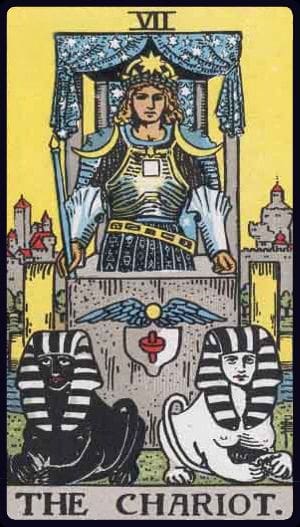
The Chariot as will
The Chariot is often described as a card of willpower.
That is true, but incomplete.
Willpower sounds like one clean force. The Chariot suggests something messier: several forces being held under conscious direction.
This is closer to how will actually works.
You do not wake up as one unified person. One part wants discipline. Another wants comfort. One part wants recognition. Another wants to disappear. One part wants the difficult conversation. Another wants three more days of pretending nothing is wrong.
The Chariot is the part of the psyche that says: all of you are coming, but we still need a direction.
That is not suppression.
At its healthiest, it is leadership.
The Chariot and inner conflict
The opposing creatures in The Chariot are one of the card’s most useful psychological images.
They suggest that movement does not require sameness.
This matters because people often wait for complete internal agreement before acting.
They want the fear to disappear before applying. They want grief to disappear before moving on. They want doubt to disappear before committing.
The Chariot says that may never happen.
A more realistic question is:
Can I move while the contradiction is still present?
That can be liberating.
You can be afraid and still go. You can be unsure and still choose. You can miss something and still leave it.
The Chariot is not the absence of conflict.
It is direction in the presence of conflict.
Curious about the card? Read it two ways
On Tarot Told Me Instagram, you can start even if you are skeptical. We read cards in Skeptical Mode as prompts for reflection and in Mystical Mode as symbols with atmosphere, archetypes, and intuition.
The Chariot and control
This is where the card becomes more complicated.
The Chariot can represent self-command, but self-command can easily slide into overcontrol.
The person who can keep everything moving may become unable to stop. The person who prides themselves on discipline may no longer know what fatigue is trying to say. The person who is excellent at pushing through may use momentum to avoid reflection.
The Chariot can therefore ask:
What am I controlling because slowing down feels dangerous?
This is often the shadow behind achievement.
Movement can become an anesthetic.
As long as there is another goal, another deadline, another city, another project, you do not have to ask whether the direction still belongs to you.
The Chariot is powerful.
That is precisely why it requires self-examination.
The Chariot as ambition
Ambition is often treated either as virtue or pathology.
The Chariot is more interesting than either.
Ambition is energy aimed at a future self.
There is nothing inherently wrong with wanting mastery, recognition, influence, money, achievement, or movement. These desires can organize life beautifully.
The question is what they organize it around.
The Chariot asks whether ambition serves a value or has become the value itself.
If every victory only creates the need for the next one, the chariot is moving but no longer arriving anywhere.
A reflective question is:
What would still matter if nobody saw me win?
That question does not kill ambition.
It tests its source.
The shadow side of The Chariot
The shadow of The Chariot is movement without integration.
Force.
Impatience.
Emotional suppression.
Winning at the wrong thing.
Using discipline to outrun vulnerability.
Treating the body like transportation for the will.
Confusing speed with progress.
This version of The Chariot can look highly functional.
That is what makes it easy to admire.
Everything gets done. The goals are clear. The person appears controlled. But underneath the momentum, parts of the psyche may be dragged rather than led.
Eventually, something refuses.
The body. The relationship. The motivation. The part of the self that has been treated as inconvenient for too long.
The Chariot’s shadow asks:
What part of me am I dragging behind the plan?
The Chariot and persona
The Chariot has a natural persona: the capable one.
The driven one.
The disciplined one.
The person who gets things done.
The one who survives.
The one who always has the next move.
This identity can be useful. It often gets rewarded.
It can also become claustrophobic.
If competence becomes the only acceptable face, then confusion, slowness, ambivalence, dependency, and exhaustion all have to go underground.
The Chariot then becomes less about direction and more about maintaining the image of direction.
A useful question is:
What would happen if I admitted that I do not feel fully in control?
For some people, that sentence is more frightening than failure.
The Chariot and individuation
In a Jungian frame, individuation does not mean becoming perfectly unified.
It means developing a more conscious relationship with the different forces shaping the self.
The Chariot fits naturally into that process.
Its task is coordination.
The opposing forces do not disappear. The psyche learns how to hold tension without automatically splitting into one acceptable side and one rejected side.
Ambition can coexist with tenderness. Independence can coexist with attachment. Discipline can coexist with fatigue. Confidence can coexist with doubt.
The mature Chariot does not require one side to be destroyed.
It learns how to move without pretending the conflict is gone.
That is a more sustainable form of strength.
Want to try it with guidance?
Tarot Told Me on YouTube has guided tarot practices, meditations, and a live stream where you can do a three-card spread in real time. Use it when you want the card to become a calm reflective practice, not another thing to decode alone.
How to interpret The Chariot as an archetype
A useful Chariot reading begins with direction, resistance, and pace.
Direction asks what you are actually trying to move toward.
Resistance asks what part of you is pulling elsewhere.
Pace asks whether the way you are moving can be sustained.
For example:
Question: Why do I feel stuck if I already know what I want?
Card: The Chariot
First reaction: He looks controlled, but tense.
Reflection: I may be expecting myself to move forward without acknowledging the part of me that is afraid of what the decision will cost.
Next step: Name the cost instead of treating hesitation as failure.
That is often enough to restore movement.
Not because resistance disappears.
Because it is finally included.
The Tarot Told Me app is built for people who want tarot to feel like a reflection space, not a prediction machine. You can ask a question, pull a card, and save what tarot told you as a note to return to later.
Reflective prompts for The Chariot
What am I trying to move forward?
What is pulling in the opposite direction?
Where has discipline become force?
What am I controlling because slowing down feels dangerous?
What would still matter if nobody saw me win?
What part of myself am I dragging behind the plan?
Is my pace sustainable?
What would coordinated movement look like instead of pure willpower?
Choose one question.
The Chariot already contains tension. Give it room.
Keep The Chariot grounded
The Chariot can easily become a motivational card.
Push harder. Stay focused. Win.
That is the least interesting reading.
A grounded Chariot asks whether the direction deserves the effort, whether the pace can continue, and whether all the important parts of you are being carried along.
Movement is useful.
Momentum can be intoxicating.
Neither guarantees that the destination is right.
The question to carry back into the day is:
Am I directing this movement, or has the movement started directing me?
When tarot is not therapy
Tarot can support journaling, self-reflection, symbolic thinking, and emotional awareness. It is not therapy, diagnosis, medical advice, legal advice, financial advice, or crisis support.
Jungian language can make a reading feel psychologically rich, but tarot should not be used to diagnose yourself or another person. If a reading increases panic, obsession, fear, or compulsive checking, stop and return to something steadier.
Suggested reading
— What Does It Mean If You Pulled The Fool Reversed
— The Emperor Tarot Card as a Jungian Archetype
—What Does It Mean If You Pulled The Star Reversed
FAQ
What is The Chariot tarot archetype?
The Chariot tarot archetype represents direction, will, discipline, momentum, ambition, self-command, and the effort to coordinate conflicting forces within the psyche.
How should beginners interpret The Chariot?
Beginners can ask, “What am I trying to move forward, and what is pulling against it?” The card often points to direction and momentum, but also to the tension required to maintain them.
What does The Chariot mean in Jungian tarot?
In Jungian tarot, The Chariot can be read as an image of conscious direction: the psyche trying to coordinate opposing impulses without allowing either one to take complete control.
Is The Chariot always a positive card?
No. It can represent confidence, discipline, and progress, but its shadow can include force, overcontrol, emotional suppression, impatience, or winning at something that no longer matters.
What is the shadow side of The Chariot?
The shadow side of The Chariot includes overcontrol, excessive ambition, pushing through exhaustion, treating vulnerability as weakness, and confusing speed or achievement with meaningful progress.
How is The Chariot connected to individuation?
The Chariot can represent learning to hold opposing parts of the psyche in conscious relationship. Individuation does not require those parts to disappear; it requires enough integration to move without suppressing them.